Adaptive tackle boxes can transform your fishing experience if you have mobility challenges. Consider easy-open magnetic closures, color-coded compartments for visual impairments, and transparent storage bags with Velcro closures. Place frequently used items in top compartments, use lightweight wheeled organizers, and install pre-cut foam inserts for simpler lure attachment. Don’t forget waterproof IP67-rated compartments to protect adaptive equipment. These practical modifications will help you focus on what matters most—enjoying your time on the water.
10 Adaptive Tackle Box Tips for Disabled Anglers
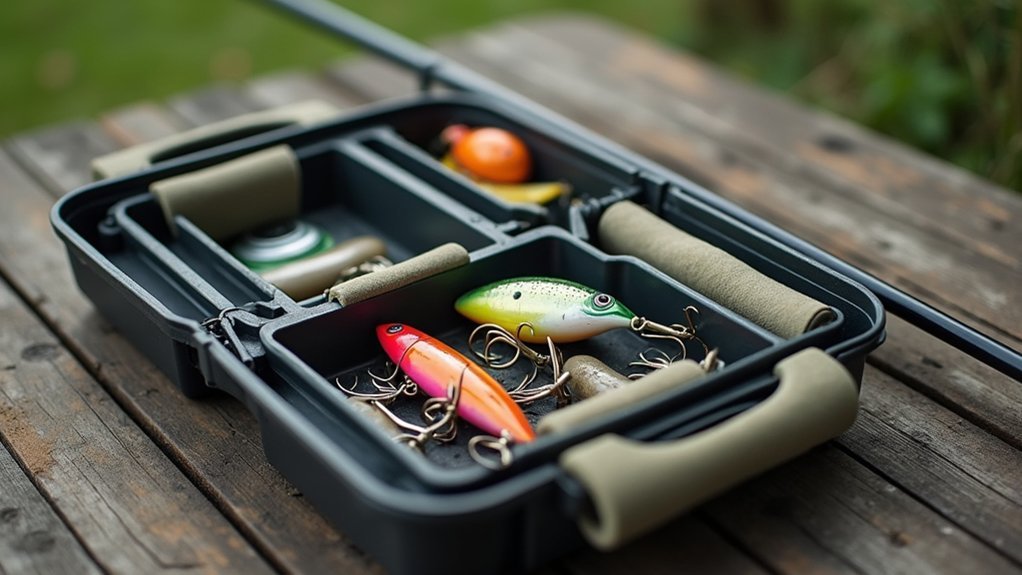
While fishing offers tremendous recreational benefits for everyone, anglers with disabilities often face unique challenges when organizing and accessing their equipment.
You’ll find that tackle boxes with easy-open features, magnetic closures, or switch-operated mechanisms can greatly improve your fishing experience.
Consider mounting your tackle box on your wheelchair using adjustable brackets or positioning it on non-slip surfaces to prevent tipping.
For those with limited hand function, grasping cuffs can help manage tackle more effectively.
Look for boxes with sorted compartments, clear labeling systems, and quick-access trays to locate gear without struggling.
Choose waterproof options with ergonomic handles and even weight distribution.
The most effective tackle solutions are modular and compatible with your existing adaptive fishing equipment, allowing for customization based on your specific needs. Products like the Fishing Grasping Cuff provide essential support for holding rods while organizing your tackle.
Organizing Your Tackle Box for One-Handed Access
For anglers who fish with one hand, whether permanently or temporarily, a well-organized tackle box becomes your most valuable companion on the water.
Choose boxes with large handles and easy-to-operate latches that you can manipulate single-handedly.
Arrange your tackle by type, keeping frequently used items in front or top compartments for quick access. Use transparent, quart-sized bags or small containers with Velcro closures to group similar lures together.
Label each section clearly so you won’t need to open multiple compartments while searching.
Load your box consistently each time to develop muscle memory, and consider customizing with adjustable dividers that match your specific fishing style. Consider implementing silica gel packs in your tackle storage to prevent moisture damage to hooks and terminal tackle.
Non-slip surfaces and ergonomic designs prevent fumbling, while stackable containers maximize storage without sacrificing accessibility.
This systematic approach lets you focus more on fishing and less on tackle management.
Magnetic Components for Easier Handling
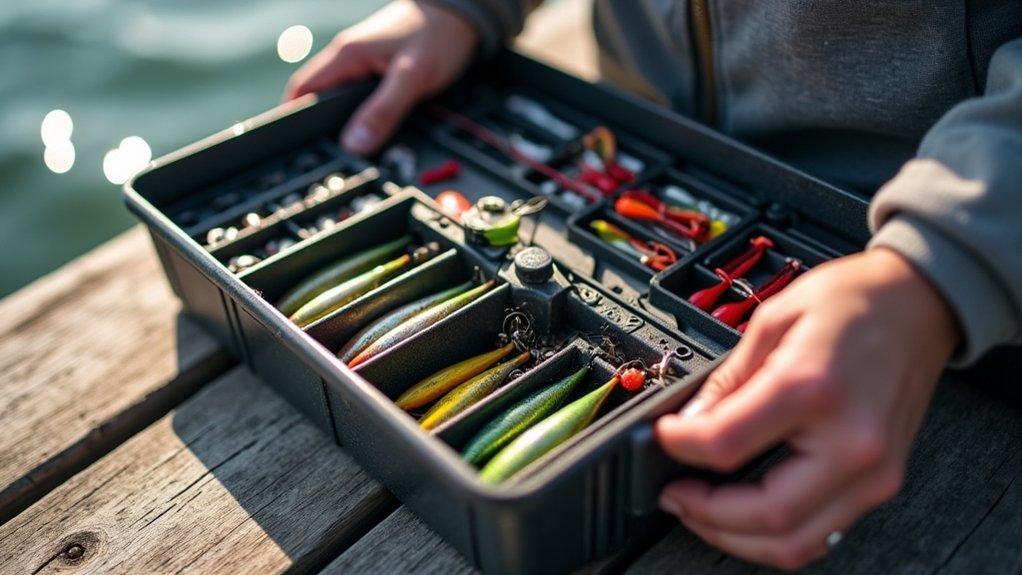
You’ll find snap-on tackle storage with magnetic elements reduces frustration when managing multiple lures or hooks with limited dexterity.
These magnetic components hold your gear securely while allowing quick removal when needed, eliminating the struggle of opening traditional clasps or compartments. The Cortland Fairplay 8-Compartment Magnetic Fly Box with its clear lid design offers excellent visibility while keeping flies secured magnetically.
Easy-release line spools featuring magnetic attachments offer you smoother casting and retrieval, preventing tangles that can be particularly challenging to manage with mobility limitations.
Snap-On Tackle Storage
The revolutionary world of magnetic snap-on tackle storage offers disabled anglers newfound independence and efficiency on the water.
These systems eliminate the frustration of rummaging through traditional tackle boxes, keeping essential gear within easy reach. The TACKLE TITAN MINI provides an affordable magnetic organization solution at just $14.99, making accessibility more budget-friendly.
Products like the JUJU Magnet and Tackle Titan’s magnetic holders provide secure storage that won’t budge, even in choppy conditions.
You’ll appreciate the installation flexibility—most systems can be mounted with minimal drilling using adhesive tapes or simple screws.
- Mount magnetic holders at convenient heights to reduce reaching and bending
- Use silicone-coated options to prevent damage to your valuable lures
- Install holders in multiple locations for customized accessibility
- Consider weight capacity—JUJU Magnets can hold up to 50 pounds of equipment
Easy-Release Line Spools
Why struggle with traditional fishing line spools when magnetic alternatives can transform your experience? These innovative spools use magnetic components that secure your line without requiring complex manual actions, perfect if you have limited dexterity or strength.
You’ll appreciate the quick-release features that make changing lines effortless. Look for models with ergonomic designs, non-slip grips, and adjustable tension settings that accommodate your specific needs. Many systems include larger handles for improved control and magnetic clasps that reduce friction points during loading and unloading.
These spools aren’t just practical—they’re versatile, fitting various reel types from spinning to baitcasting. They store compactly in your tackle box and often feature built-in safety mechanisms like automatic line cutters. Some adaptive anglers find that using old koozies to secure their spools provides an additional layer of organization when managing multiple line types.
You’ll spend less time wrestling with equipment and more time enjoying what matters—the fishing itself.
Color-Coding Systems for Visual Impairments
Four essential color-coding strategies can dramatically improve a visually impaired angler’s fishing experience.
Visual techniques empower visually impaired anglers to overcome challenges and enhance fishing success through smart color organization.
By implementing these techniques, you’ll enhance tackle organization and fish-catching success regardless of visual limitations.
1. Contrast is vital – Use bright, high-contrast colors for your tackle box organization.
Illuminated displays can greatly improve visibility when sorting through lures and other equipment.
2. Pre-load by color – Organize compartments with color-coded labels and pre-loaded tackle sorted by hue to enable quick identification and selection on the water.
3. Match conditions with colors – Select lures based on time of day and water clarity.
Study which colors attract specific species in various environments. In stained water conditions, focus on lures with strong contrast rather than intricate color details that won’t be visible to fish.
4. Employ technology – Utilize digital color guides or smart tackle boxes with built-in lighting to enhance your ability to distinguish between similar items.
Lightweight Design Options for Mobility Challenges
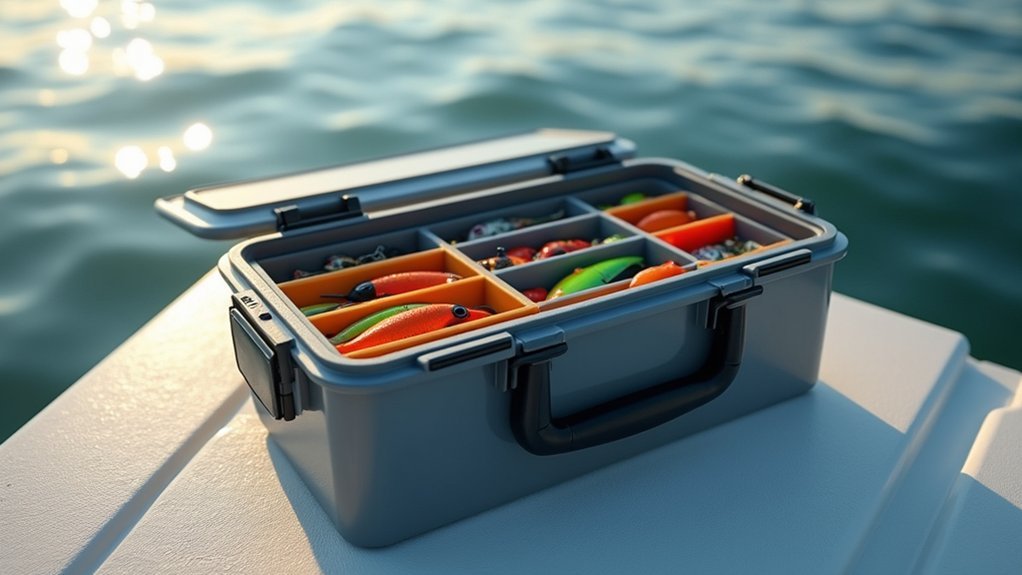
If you’re facing mobility challenges, wheeled tackle organizers can eliminate the need to lift and carry heavy equipment while providing smooth transportation across docks and piers.
Float-based storage solutions offer the advantage of keeping your gear accessible without physical strain when fishing from boats or shorelines.
Sling-style box options distribute weight evenly across your body, reducing pressure on joints and allowing one-handed access to your fishing supplies. The Beyond Fishing Tackle Bag features adjustable double straps for enhanced comfort, making it an excellent option for anglers with limited mobility.
Wheeled Tackle Organizers
Choosing the right wheeled tackle organizer can dramatically improve fishing accessibility for anglers with mobility challenges.
Look for models with wide, sturdy wheels that navigate various terrains easily and aluminum frames that provide strength without excess weight. The best options feature adjustable, ergonomic handles to accommodate different heights and grip capabilities. Quality wheeled systems enhance fishing efficiency by keeping tackle dry and secure while allowing mobility without assistance.
- Select organizers with retractable handles that allow you to pull the cart close to your fishing spot without obstruction.
- Prioritize models with braking mechanisms to prevent unwanted movement on slopes.
- Consider carts with integrated seating options for rest during extended fishing sessions.
- Look for customizable compartments and clear trays that let you organize tackle according to your specific needs and easily identify contents.
Float-Based Storage Solutions
Float-based storage solutions represent a game-changing innovation for anglers with mobility challenges, combining the essential features of buoyancy with lightweight design.
These tackle boxes use high-toughness PE materials that resist cracking while maintaining minimal weight for easier transport.
You’ll appreciate the waterproof elements like silicone gaskets that protect your gear from moisture, while the buoyant construction guarantees your tackle box won’t sink if accidentally dropped overboard. The design is especially valuable when wading in shallow water, making fishing in tidal areas more accessible for those with disabilities.
For added security, attach a rope to connect the box to a life ring or boat.
Look for models with ergonomic handles and easy-to-open compartments that accommodate limited dexterity.
Many options include adjustable dividers so you can customize storage for your specific needs.
When shopping, consider using promotional codes like TK20 or TK40 to make these adaptive solutions more affordable.
Sling-Style Box Options
Sling-style tackle boxes offer innovative solutions for disabled anglers who face mobility challenges, providing comfort and accessibility without compromising on functionality.
These lightweight designs feature water-resistant materials like PVC-backed nylon that protect your gear while remaining easy to manage. For anglers with limited hand mobility, the fishing experience can be enhanced with electric fishing reels that provide variable-speed control.
- Adjustable configurations – Many models like the Osage River Gear can be worn in multiple positions, adapting to your specific mobility needs.
- Quick-access compartments – Zippered pockets with easy-grab pulls accommodate limited dexterity.
- Hands-free options – Built-in rod holders free your hands for mobility assistance devices.
- MOLLE systems – Allow customization with additional pouches positioned exactly where you need them.
The EGO Kryptek and KastKing sling packs receive particularly positive reviews from anglers with disabilities for their comfortable wear and intuitive designs that don’t hinder movement.
Securing Your Tackle Box to Mobility Devices
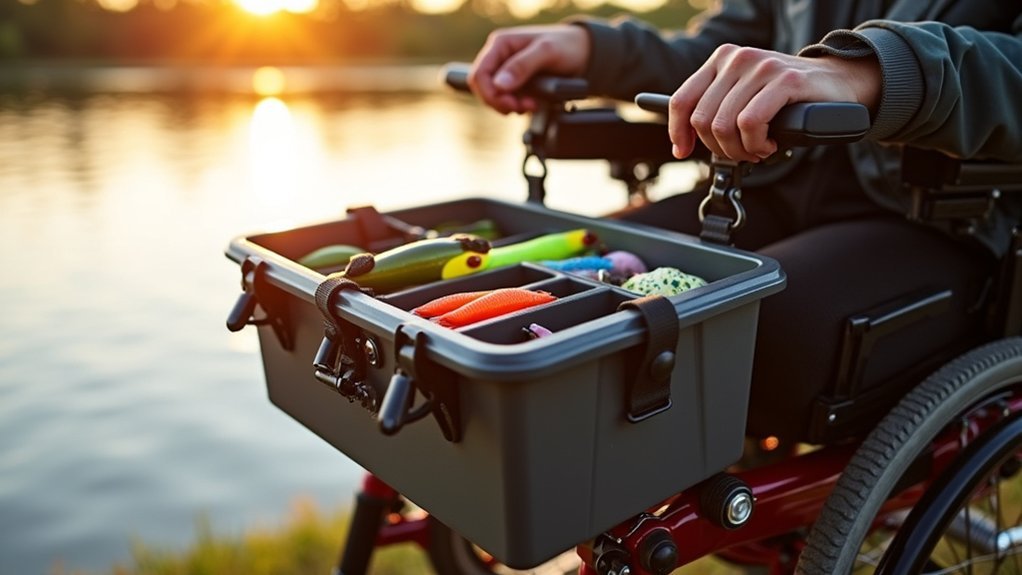
While fishing enthusiasts with disabilities deserve full access to the sport, securing tackle boxes properly to mobility devices remains a critical safety concern. You’ll need different strategies depending on your mobility aid.
| Device Type | Recommended Securing Method |
|---|---|
| Wheelchair | Use bungee cords or straps at accessible height |
| Scooter | Apply tie-downs with even weight distribution |
| Stroller | Secure with adjustable straps near center of gravity |
| Kayak | Employ bungee cords and waterproof containers |
| Other Devices | Choose versatile attachment systems for flexibility |
When selecting your tackle box, prioritize compact, lightweight options that won’t compromise your mobility. Position your gear at a comfortable height for easy access while fishing. Always check that all securing mechanisms are tight and reliable before heading out to your fishing spot. For wheelchairs, consider mounting rod holders for hands-free fishing, enhancing your control and stability on the water.
Quick-Release Compartments for Limited Dexterity
Quick-release compartments represent a game-changer for anglers with limited dexterity. These innovative designs reduce the force needed to access your gear, featuring large ergonomic tabs and push-button mechanisms that eliminate complex twisting motions.
Look for boxes with transparent lids so you can identify contents without repeated opening.
When selecting a tackle box with quick-release features, prioritize:
- Magnetic or push-button releases that require minimal hand strength
- Adjustable dividers you can customize without complex manipulation
- Non-slip, textured grips along compartment edges for easier handling
- Lightweight materials that don’t sacrifice durability or water resistance
Many popular brands now incorporate these adaptive elements, responding to feedback from anglers with mobility challenges.
These thoughtful designs guarantee you’ll spend less time struggling with equipment and more time enjoying your fishing experience.
The SPRO 3500 Reversible Tackle Box offers an excellent option with its waterproof design that protects gear while providing easy access for those with limited dexterity.
Waterproof Solutions for Electronic Adaptive Equipment
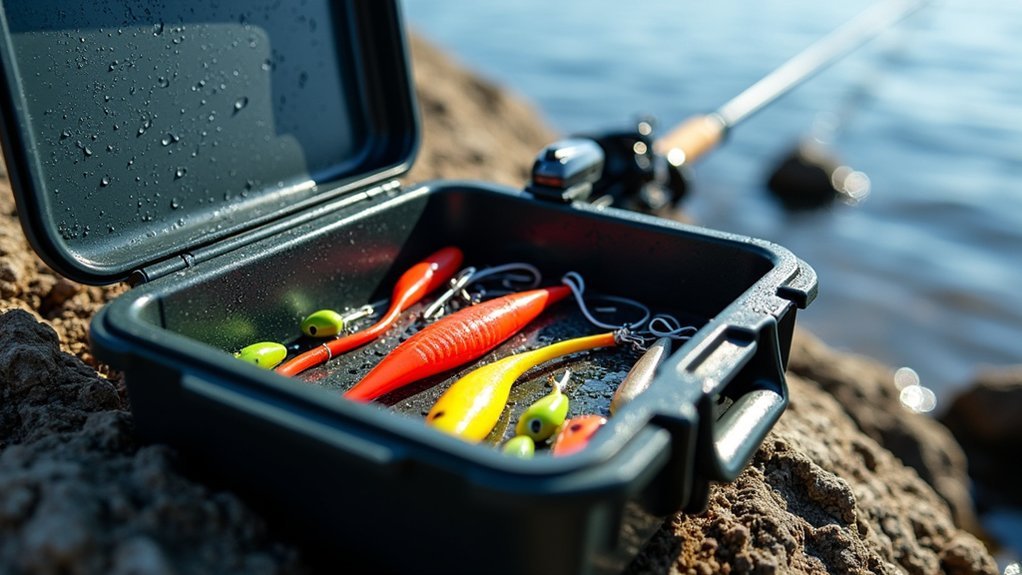
For anglers who rely on electronic adaptive equipment, waterproofing isn’t just a convenience—it’s essential for protecting valuable assistive technology.
Look for tackle boxes with IP67-rated compartments that can withstand submersion and feature rubber gaskets at all seams.
Protect your circuit boards with conformal coatings and store devices in custom-fitted waterproof pouches with desiccant packets.
Choose equipment with sealed battery housings and waterproof connectors to prevent corrosion and electrical shorts.
After each fishing trip, rinse salt-exposed gear with fresh water and thoroughly dry everything before storage.
Regularly inspect for worn gaskets or compromised seals and replace them according to maintenance schedules.
Consider newer wireless charging options that eliminate the need for exposed charging ports, reducing water damage risks.
The Freedom Fisher Power Assist Reel with its 12V motor is particularly vulnerable to water damage, so proper waterproofing is critical for maintaining its one-handed operation capabilities.
Customizable Foam Inserts for Personalized Organization
Customize your tackle box with foam inserts that feature specialized multi-compartment systems to reduce the need for complex hand movements and improve accessibility.
You’ll find visual identification stickers incredibly helpful for quickly locating specific lures when visibility or recognition is challenging.
Consider creating ergonomic lure stations within your foam inserts, where frequently used tackle can be positioned at ideal angles for your specific mobility needs.
The Meiho Slit Form cases offer pre-cut foam inserts with slits that make attaching flies and lures much easier for those with limited dexterity.
Specialized Multi-Compartment Systems
Three key features define customizable foam inserts for anglers with disabilities. They provide tailored organization for your tackle, offer a snug fit that prevents items from shifting during transport, and can be easily modified as your equipment needs change.
These inserts transform standard tackle boxes into personalized solutions that address specific mobility challenges. When paired with push-button controls, these systems become even more accessible, resembling the user-friendly operation of advanced adaptive fishing equipment.
When selecting a multi-compartment system, look for these essential features:
- Adjustable dividers that can be reconfigured without tools to accommodate different tackle sizes
- Color-coded sections to help you quickly identify gear types, especially beneficial for visually impaired anglers
- Tactile markings on compartments for identification by touch when visibility is limited
- Lightweight, durable materials that won’t add unnecessary weight to your fishing setup
Visual Identification Stickers
Visual identification stickers serve as essential navigation tools for disabled anglers who need quick and efficient access to their fishing gear.
You’ll find these durable labels in various materials including UV scratch-resistant ink and foil with clear coatings for maximum longevity.
Apply labels to multiple sides of your tackle boxes for easy identification regardless of how they’re stored. This is particularly helpful when you can’t easily manipulate containers.
Consider color-coding your stickers to quickly distinguish between different tackle types—red for lures, blue for hooks, green for weights.
For those with visual impairments, use large, high-contrast lettering on your labels.
While standard office printers work well for creating custom labels, you can also incorporate personalized designs that match specific tackle types, making identification even more intuitive.
Products like Tackle Decals offer 72 unique labels designed specifically for fishing tackle organization across various categories including terminal tackle, jigs, and baits.
Ergonomic Lure Stations
Designed for maximum accessibility, ergonomic lure stations with customizable foam inserts transform tackle organization for disabled anglers.
These precision-cut inserts secure your lures while allowing for easy retrieval, reducing strain on hands and fingers. The precision CNC routed foam provides a perfect fit for your specific tackle box, ensuring maximum efficiency in your setup. The high-density foam holds hook points securely without damaging them, preventing accidental pokes when reaching for tackle.
- Easy-to-modify layouts – Adjust dividers and inserts as your collection changes or when your accessibility needs evolve
- Double-sided options – Maximize storage with foam inserts on one side and traditional compartments on the other
- Slotted designs – Enable hook-free handling of lures, even while wearing gloves
- Visibility features – Display entire lure color profiles for quick identification when selecting the perfect bait
These customizable stations keep your tackle organized, protected, and ready for your next fishing adventure.
Extended Handles and Pull Tabs for Improved Grip
For anglers with limited dexterity or strength, extended handles and pull tabs represent game-changing innovations in tackle box design. These adaptive features provide essential leverage and control when you’re managing your fishing gear.
Extended handles increase your reach while reducing fatigue during long fishing sessions. They allow you to apply more force with less effort, making them ideal if you have mobility limitations or reduced strength.
Pull tabs with ergonomic shapes and non-slip materials make opening compartments greatly easier. Look for large tabs that you can grasp firmly without straining your fingers. These designs are particularly beneficial for seniors with arthritis or disabilities who struggle with traditional tackle box latches.
Many modern designs feature adjustable tabs that accommodate different grip styles.
When selecting these adaptive features, prioritize non-slip surfaces and stable designs that prevent accidents—especially important when you’re fishing in wet conditions.
Frequently Asked Questions
How Do I Fund Expensive Adaptive Fishing Equipment?
You can fund expensive adaptive fishing equipment through nonprofit grants from CAF or Move United, local community support, manufacturer assistance programs, and crowdfunding platforms. Apply to multiple organizations simultaneously to increase your chances.
Can Adaptive Fishing Equipment Be Used in Extreme Weather Conditions?
Yes, you’ll find most adaptive fishing equipment is durable in extreme weather. Look for waterproof electronics, stainless steel components, and protective covers. Regular maintenance will keep your gear functioning well in harsh conditions.
Are There Specific Fishing Locations Recommended for Wheelchair Accessibility?
You’ll find excellent wheelchair accessibility at Lake Poway (California), Lake Monroe (Indiana), Beaver Lake (Arkansas), and Lake Chabot (California). Many Texas state parks also offer accessible piers with paved paths and nearby accessible restrooms.
How Often Should Adaptive Equipment Be Inspected for Safety?
You should inspect your adaptive equipment monthly for visual damage, quarterly for functional checks, and annually for thorough evaluation. Don’t skip inspections—they’re critical for ensuring your safety while using these specialized tools.
Are There Virtual Communities Where Disabled Anglers Share Tackle Box Modifications?
Yes, you’ll find disabled anglers sharing tackle box modifications on Corpusfishing.com forums, Virtual Angling’s subscription platform, and Oregon Spinal Cord Injury Connection’s educational sessions. These communities offer valuable peer support and practical adaptation ideas.
In Summary
With these adaptive tackle box modifications, you’ll enjoy fishing with greater independence and less frustration. Don’t let mobility or dexterity challenges keep you from the water—your customized tackle system can accommodate your specific needs. Remember, it’s about making small adjustments that create big improvements in your fishing experience. The perfect adaptive tackle box isn’t just practical—it’s your gateway to continued angling enjoyment.