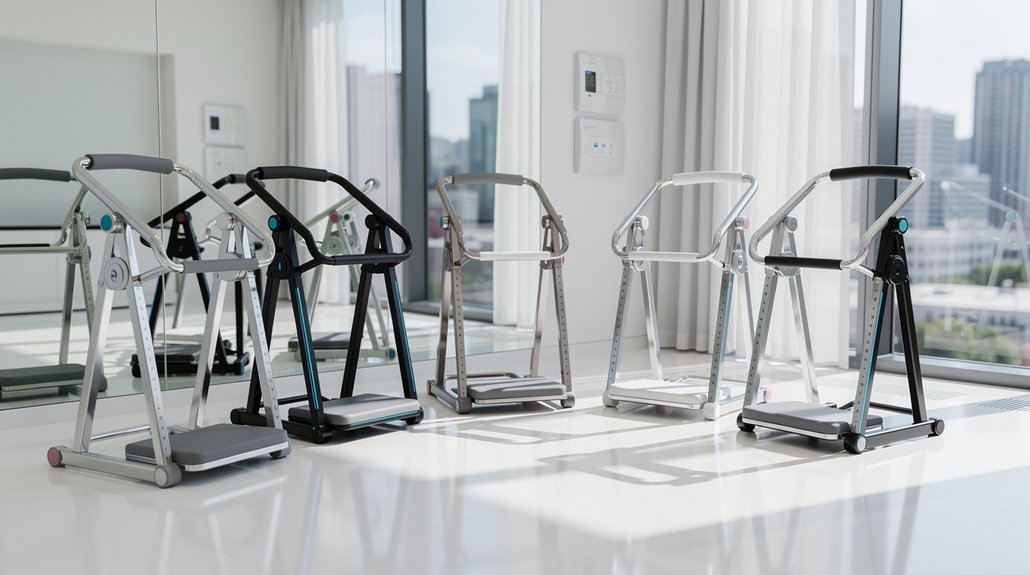
Parkour can be modified for all abilities through adaptive techniques focused on foundational skills. You’ll benefit from body awareness exercises like supported squats and seated movements before progressing to wheelchair momentum techniques or partner-assisted vaults. Start with lower obstacles, use balance aids when needed, and focus on proper execution rather than difficulty. Many modifications use portable ramps, stability supports, and community encouragement. The journey to parkour mastery begins with understanding your unique movement potential.
Parkour Exercises Modified for All Abilities
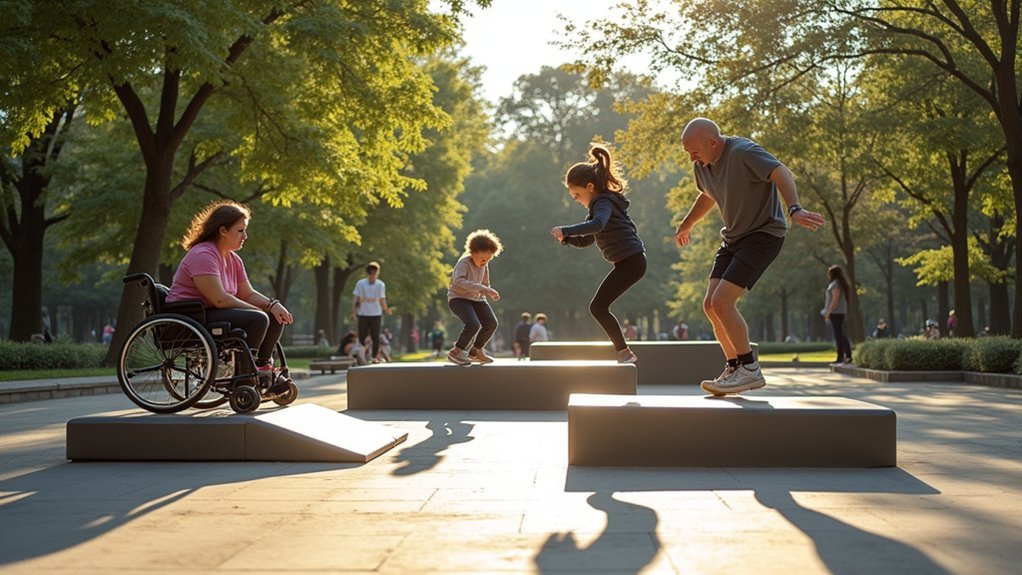
While many view parkour as an extreme sport for the physically elite, its fundamental movements can be adapted for practitioners of all abilities and fitness levels.
Basic parkour movements like vaults can be practiced on lower surfaces, while upper body exercises might begin from a seated position to build necessary strength gradually.
Start with modified exercises such as supported air squats or reduced-range wall dips to develop confidence before advancing.
Crawling drills can be adjusted by changing distance and speed, allowing you to progress at your own pace while improving core stability.
For jumping exercises, focus on proper technique rather than distance.
Utilize props like boxes or mats to create safe progressions for movements like standing jumps, making these dynamic skills accessible regardless of your current abilities.
Understanding the Parkour Mindset for Adaptive Athletes
At the heart of parkour lies a mindset that transcends physical limitations, making it uniquely accessible for adaptive athletes. Rather than focusing on what you can’t do, parkour encourages you to explore what you can, adapting movements to your unique abilities and finding creative solutions to obstacles.
This approach fosters a growth mindset where progress isn’t measured against others but through personal improvement. You’ll learn to emphasize your strengths while modifying techniques to suit your individual needs.
The parkour community embraces inclusivity, creating supportive environments where everyone can participate regardless of physical ability.
Essential Body Awareness Techniques for Modified Movement
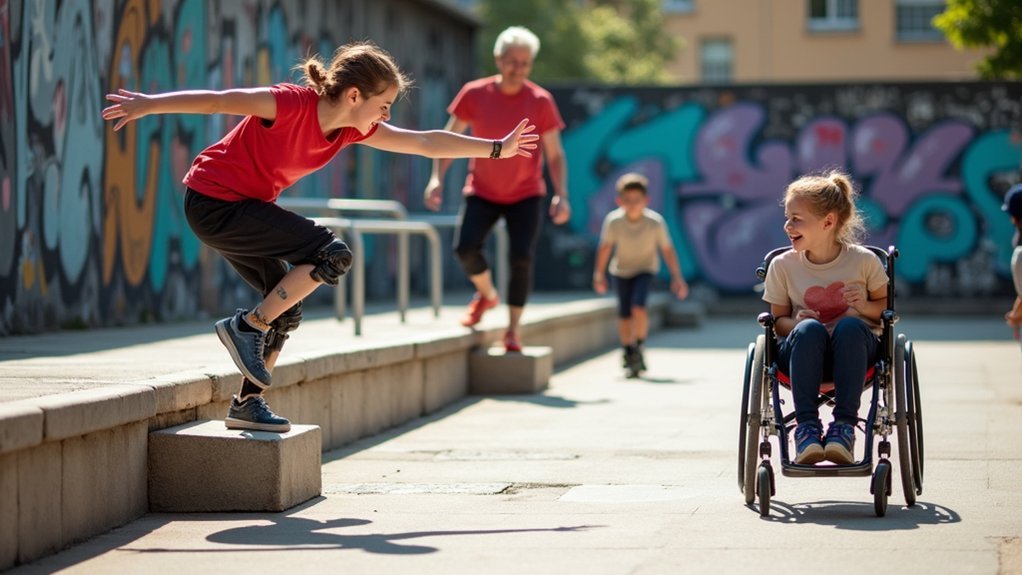
Body positioning forms the foundation of adapted parkour, requiring you to understand how your unique physiology interacts with the environment before attempting any movements.
You’ll develop this awareness through simple spatial drills like mapping your personal reach zones or practicing controlled weight transfers between different body parts.
These techniques help you build a mental map of your capabilities, creating a safer framework for exploring modified parkour movements that work specifically for your body.
Body Positioning Foundations
Before attempting any parkour movement, mastering body positioning serves as the cornerstone for safe and effective practice. Understanding how your head, shoulders, hips, and feet align creates a foundation that works regardless of your current body strength or mobility limitations.
You’ll find that core engagement dramatically improves your stability during movements, allowing for smoother shifts between techniques. Start by practicing basic alignment in static positions, then gradually introduce motion while maintaining awareness of your body’s orientation in space.
Use mirrors or record yourself during practice sessions to visualize your positioning and make real-time adjustments. Incorporate fundamental movements like crawling and rolling to build body positioning awareness naturally.
These foundational exercises develop the proprioceptive skills needed for more complex parkour techniques while adapting to your individual capabilities.
Spatial Awareness Drills
Spatial awareness forms the natural next step after mastering body positioning fundamentals. Developing your ability to navigate environments effectively requires training your proprioception—your body’s internal positioning system.
Try these accessible drills to enhance your spatial awareness:
- Practice “shadowing” with a partner, mirroring their movements to develop coordination in a supportive setting.
- Use visual markers to help gauge distances and angles as you move through your training space.
- Incorporate balance exercises like walking along lines or narrow surfaces to strengthen proprioception.
- Experiment with movement patterns across varied terrains to build adaptability.
- Gradually introduce height variables to improve your ability to assess spatial dynamics.
These drills will help you understand how your body relates to obstacles, making your parkour practice more efficient and controlled regardless of your ability level.
Wheelchair Parkour: Building Momentum and Navigation Skills
Mastering wheelchair parkour starts with building momentum as you propel yourself through urban obstacles, using controlled acceleration and deceleration to navigate diverse terrains.
You’ll develop chair-based balance techniques that enhance your ability to maintain control during wheelies, bunny hops, and shifts between surfaces of varying heights.
These skills work together to transform ordinary architectural features into creative pathways that showcase your increasing mobility confidence and spatial awareness.
Momentum Through Obstacles
While traditional parkour athletes use their legs to vault and jump, wheelchair parkour practitioners harness the power of momentum to navigate their environment with remarkable fluidity.
Your success depends on building upper body strength and mastering techniques that maintain continuous motion through urban landscapes.
- Use slight downhill grades to build initial momentum before approaching obstacles
- Practice wheelies to navigate over small curbs without losing speed
- Develop side hop techniques to maneuver around narrow passages
- Learn to “pump” your chair through flat sections to maintain momentum
- Master weight shifts to balance during high-speed turns and shifts
Community engagement through training sessions can accelerate your progress, as experienced practitioners share techniques for flowing through obstacle sequences efficiently.
With practice, you’ll discover your wheelchair isn’t a limitation but a unique tool for experiencing parkour’s freedom.
Chair-Based Balance Techniques
Balance lies at the heart of wheelchair parkour, requiring practitioners to develop a unique set of skills unlike those in traditional parkour.
You’ll need to focus on building core stability while strengthening your upper arms and shoulders to maintain control during movements.
Practice chair-based balance exercises like chest pulls and lateral reaches to enhance your ability to navigate obstacles with precision.
Try wheel lifts and coordinated turns to improve your maneuverability between surfaces. These techniques help you develop the necessary muscle memory for smoother changes.
When approaching obstacles, learn to push off surfaces strategically, using momentum rather than pure strength to overcome barriers.
Regular practice of these chair-based balance techniques won’t just improve your parkour skills—you’ll gain better overall coordination and physical fitness for everyday mobility challenges.
Seated Balance Drills for Core Strength Development
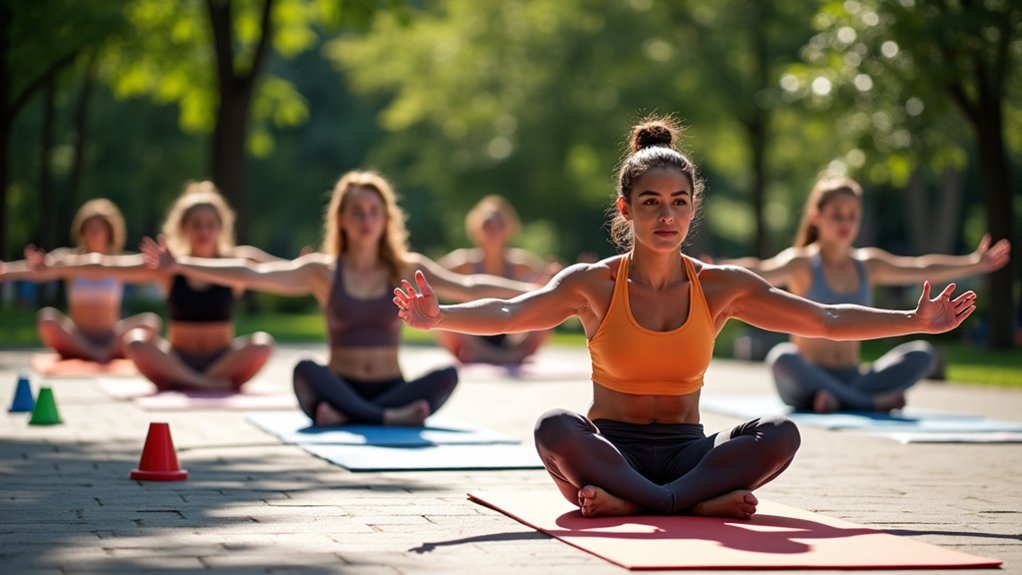
Before attempting complex parkour maneuvers, you’ll need to develop a solid foundation of core strength through seated balance exercises.
These drills engage your stabilizing muscles while minimizing injury risk, regardless of your current abilities. Regular practice improves postural control and develops functional strength, building confidence for more dynamic parkour skills.
- Try seated leg lifts to challenge your core stability while maintaining proper posture.
- Incorporate torso twists to enhance coordination and rotational strength.
- Add light weights during exercises to progressively increase difficulty.
- Use resistance bands for additional challenge as your core strength improves.
- Practice these drills consistently to create a solid foundation for standing balance work.
As you master these seated exercises, you’ll develop the core stability essential for executing parkour movements safely and effectively.
Wall and Rail Interactions for Limited Mobility Practitioners
Wall and rail interactions can be effectively adapted through seated rail traverses that build your grip strength while remaining safely supported.
Chair-to-wall adjustments offer you practical movement patterns that develop upper body control using resistance bands for assistance when needed.
Low-impact barrier approaches let you practice fundamental parkour concepts by maneuvering smaller obstacles with modified techniques, gradually building confidence in your spatial awareness.
Seated Rail Traverses
Three core elements of parkour—strength, coordination, and environmental awareness—come together in seated rail traverses, making them ideal for practitioners with limited mobility.
You’ll develop essential grip strength while using walls or rails as support systems in a seated position, enhancing your body awareness without requiring full-body movement.
- Start with low rails to build confidence before progressing to higher challenges
- Pull yourself along the rail to improve upper body control in a safe environment
- Add resistance bands to either assist your movements or increase difficulty
- Practice regularly to enhance your connection to your surroundings
- Focus on smooth, controlled movements to maximize coordination benefits
As you practice seated rail traverses, you’ll discover how parkour’s principles adapt beautifully to different physical capabilities while still delivering genuine skill development.
Chair-to-Wall Transitions
When traditional parkour seems out of reach due to mobility challenges, chair-to-wall shifts offer an accessible gateway into the practice’s fundamental techniques. These modified exercises use a sturdy chair as your stepping point to safely engage with vertical surfaces.
Begin with seated wall pushes, pushing away from the wall while maintaining balance. As you build confidence, progress to standing positions where you can practice controlled movements between the chair and wall. These movements develop essential upper body strength while accommodating your specific mobility needs.
You can customize the experience by adjusting chair height and selecting appropriate walls or rails. Incorporate grip training by holding onto rails during movements.
The beauty of chair-to-wall shifts lies in how they maintain parkour’s essence—creative movement through your environment—while adapting to your unique capabilities.
Low-Impact Barrier Approaches
Moving beyond chair-based exercises, low-impact barrier approaches offer another accessible pathway into parkour for those with mobility limitations.
You’ll find walls and rails excellent training tools that build upper body strength without jarring impacts on your joints.
Start with these modified movements to develop parkour fundamentals safely:
- Wall sits and supported leans to build foundational strength
- Wall dips to develop upper body strength while controlling your movement speed
- Simple rail walks using the rail for balance assistance
- Seated rail shifts to improve coordination
- Gradual progression from basic wall touches to assisted vaults
As you practice these low-impact techniques, you’ll develop confidence and stability.
Consider using adaptive equipment like balance aids when needed—they’re valuable tools that make parkour more inclusive and accessible while maintaining the discipline’s creative spirit.
Precision Jumps and Landings Adapted for Varying Abilities
Mastering precision jumps forms the cornerstone of parkour practice, regardless of your current fitness level or mobility. Begin with ground-level jumps to develop landing control before progressing to elevated surfaces. You’ll build confidence faster by starting on soft surfaces like grass or mats, allowing you to focus on technique rather than fear of impact.
| Ability Level | Target Distance | Recommended Surface |
|---|---|---|
| Beginner | 1-2 feet | Grass/Mats |
| Novice | 2-3 feet | Foam Pit/Mats |
| Intermediate | 3-4 feet | Rubber/Wood |
| Advanced | 4-6 feet | Concrete/Rails |
| Expert | 6+ feet | Variable Surfaces |
Use visual markers like tape or cones to target your landings more effectively. As you advance, incorporate obstacles of varying heights to challenge your precision jumps and develop adaptability in different environments.
Upper Body Conditioning for Assisted Parkour Movements
Although precision jumps focus on lower body skills, assisted parkour movements depend heavily on upper body strength and control.
To develop the necessary pulling and pushing power for vaults and climb-ups, you’ll need targeted conditioning exercises that work for all ability levels.
Building functional parkour strength requires structured conditioning that bridges the gap between where you are and where you want to be.
- Start with wall dips, which you can modify by using lower surfaces if you’re a beginner.
- Practice straight-arm wall support to build foundational upper body strength.
- Try tactical pull-ups with your thumb on top of the bar to mimic climbing grip.
- Use jump-assisted pull-ups if you’re still developing your upper body strength.
- Perform these exercises consistently to improve balance and control during parkour movements.
These exercises don’t just build muscle—they’ll help you shift smoothly between movements while maintaining control throughout your parkour practice.
Sensory-Guided Pathways for Vision-Impaired Traceurs
While many assume parkour requires perfect vision, vision-impaired individuals can experience the joy of movement through specially designed sensory-guided pathways.
These adaptive environments use tactile ground surfaces like rubber mats or gravel, allowing vision-impaired practitioners to identify different zones through touch, dramatically improving spatial awareness.
Sound cues play an essential role too. Clapping or electronic beeping devices help you gauge distance and direction when executing movements.
You’ll benefit from training in a collaborative environment with guiding partners who provide verbal instructions and physical support when needed.
Start with adapted exercises such as guided rolling or jumping over low obstacles.
As you progress, you’ll develop confidence and skill through these sensory-rich pathways, proving that parkour truly can be accessible to everyone regardless of visual ability.
Partner-Assisted Vaults and Traverse Techniques
Teamwork transforms parkour into a collaborative experience where beginners can safely explore advanced movements.
Partner-assisted vaults allow you to develop fundamental parkour skills while building confidence through physical support from a teammate.
- Try modified Monkey Vaults with a partner steadying your hips as you shift over obstacles.
- Practice Precision Jumps with a spotter who guides your landing to guarantee proper form.
- Build grip strength through partner-assisted traverses where your teammate provides stabilization.
- Focus on communication during partner work—clear signals enhance safety and effectiveness.
- Use partner feedback to refine technique before attempting solo movements.
This collaborative approach not only accelerates skill development but also fosters teamwork essential to parkour community values, creating a supportive environment where practitioners of various abilities can progress together.
Adaptive Equipment Solutions for Parkour Participation
The inclusion of adaptive equipment has revolutionized parkour accessibility, enabling practitioners of all physical abilities to experience the discipline’s freedom and challenges.
Specialized mats and padding create safe landing surfaces, minimizing injury risks while you build confidence in your movements.
For those with limited hand strength, customizable grips and handles make vaults and climbs achievable, allowing you to execute techniques properly.
If you’re facing mobility challenges, lightweight portable ramps provide accessible pathways for practicing jumps and shifts safely.
Balance aids like walking canes or stability bars can be incorporated into your training to improve core strength and coordination.
These adaptive equipment solutions, combined with tailored training programs accommodating various skill levels, foster an inclusive environment where everyone can discover the joy of movement through parkour.
Frequently Asked Questions
How to Improve Your Parkour Skills?
Begin with basic strength exercises like air squats and wall dips. Practice mobility drills, develop explosive power through jumps, and gradually advance your skills. Use your environment creatively, turning everyday obstacles into training opportunities.
Is 40 Too Old to Start Parkour?
No, 40 isn’t too old to start parkour. You can begin at any age with appropriate modifications. Your body will adapt gradually, and you’ll develop valuable strength, balance and coordination while training within your capabilities.
How to Build Strength for Parkour?
You’ll build strength for parkour through bodyweight exercises like pull-ups, jump squats, and broad jumps. Focus on explosive movements, grip strength, and core stability. Train consistently 2-3 times weekly for best results.
What Are the Most Important Muscles for Parkour?
Your parkour journey depends heavily on your legs (quads, hamstrings, calves), core (abs, obliques), and upper body (lats, triceps). Don’t forget grip strength – it’s essential for climbs and obstacle manipulation.
In Summary
You’ve now got the tools to transform obstacles into opportunities, regardless of your physical abilities. By adapting parkour principles to your unique needs, you’ll build confidence, strength, and spatial awareness that extends beyond training. Remember, parkour isn’t about performing specific moves—it’s about finding your own path through life’s challenges. Keep exploring, adapting, and discovering what your body can achieve.