

Adaptive arm support harnesses can transform your fishing experience by enhancing stability and reducing fatigue while casting and reeling. These customizable systems—available in chest-mounted, forearm, or side-mounted designs—provide essential support for anglers with mobility limitations. You’ll find options compatible with electric reels and various rod holders to minimize physical strain and maximize time on the water. The right harness paired with proper technique allows even those with significant disabilities to reclaim their fishing independence and confidence.
How Adaptive Arm Support Harnesses Revolutionize Independent Fishing
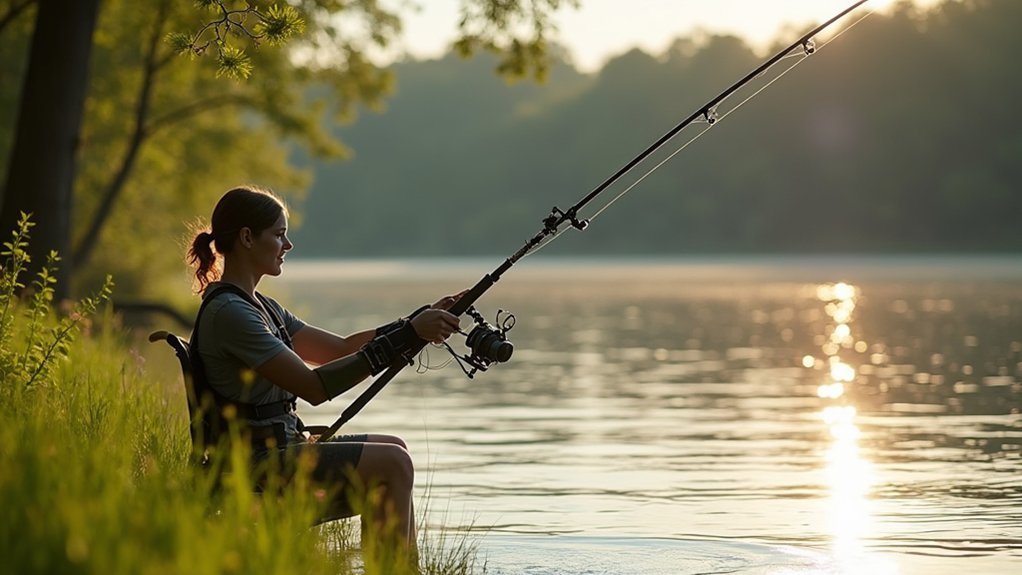
While fishing has traditionally presented challenges for individuals with limited mobility, adaptive arm support harnesses have transformed the landscape of independent angling. You’ll enjoy enhanced control and stability while casting and reeling, allowing you to fish without assistance.
These innovative devices offer you improved leverage when fighting fish, reducing fatigue and extending your time on the water. With chest-mounted, forearm, or side-mounted options, you’ll find a design that fits your specific needs.
The adjustable features let you customize the fit for your body and preferred fishing rod. You’re no longer limited by mobility constraints – you can participate in fishing trips, join community events, and develop your skills independently. These harnesses complement other adaptive fishing equipment like rod mounts and electric reels that assist users with limited hand function.
The confidence you’ll gain from self-sufficient fishing extends beyond the sport itself.
Selecting the Perfect Harness for Your Specific Mobility Needs
How do you choose a harness that truly meets your unique mobility requirements? Start by evaluating your specific needs. Chest harnesses offer stability for those with trunk control issues, while forearm mounts provide precision for users with upper body strength. The innovative Rexfly Chest Harness comes standard with both adaptive spinning and casting rods to provide excellent support during use.
| Harness Type | Best For |
|---|---|
| Chest Harness | Full upper body support, stability during casts |
| Forearm Mount | Enhanced rod control, users with good shoulder mobility |
| Wheelchair Mount | Hands-free fishing, wheelchair users |
| Custom Solutions | Complex mobility issues, unique positioning needs |
| Fighting Belt | Larger catches, users with core strength |
Consider your fishing environment too—boat fishing may require different support than shoreline angling. Don’t hesitate to try several options; the perfect harness should feel like a natural extension of your body.
Step-by-Step Guide to Setting Up Your First Arm Support System
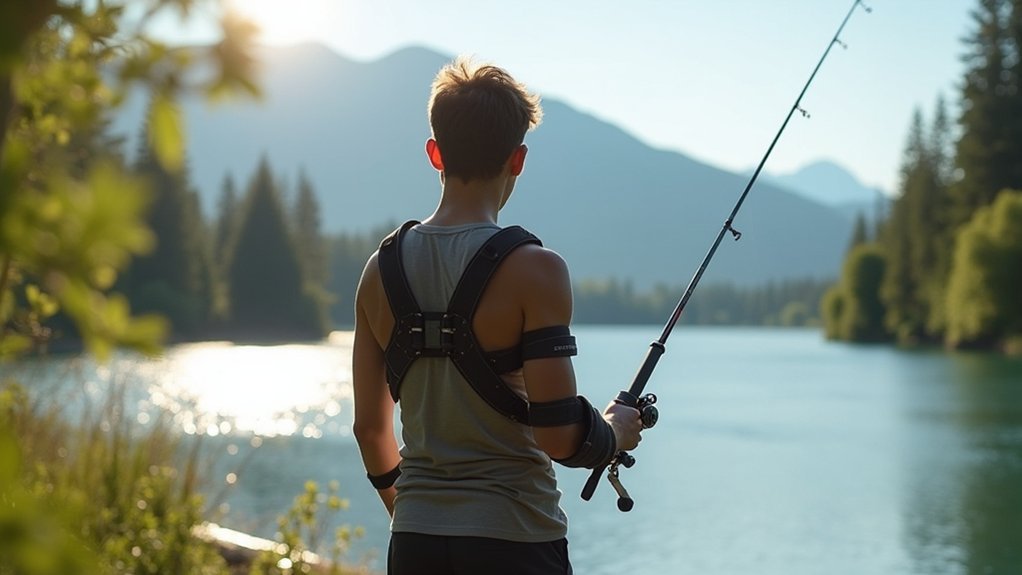
Setting up your first adaptive arm support harness might seem challenging, but with systematic preparation, you’ll be fishing comfortably in no time.
Begin by verifying all components: straps, guides, screws, spacers, and backing plates.
Check your kit first: ensure you have all straps, guides, screws, spacers and backing plates before assembly.
Install harness guides by aligning attachment holes with the harness shell eyelets. Secure with Allen head screws, then attach buckle loops around guide bases.
Position guides at ideal angles for your comfort, initially mounting them loosely to allow adjustment.
Once positioned correctly, tighten all connections with a 4mm Allen key.
Attach your rod holder system to the harness, ensuring it allows quick release when needed. The PVC pipe design with beveled cutouts prevents rod rotation while providing stable support during reeling. Test functionality by simulating casting motions.
Before heading out, perform a safety check confirming all screws are properly tightened and the system provides suitable support without restriction.
Real Success Stories: Anglers Returning to Their Passion
You’ll find inspiration in the stories of veterans who’ve reclaimed their fishing passion despite limb loss or limited mobility.
These “water warriors” harness innovative adaptive systems like the Rexfly Chest Harness and Barracuda Rod Holder to overcome physical barriers that once seemed insurmountable.
Customized equipment like leather cuffs designed specifically to hold fishing rods enable anglers to maintain control and independence on the water.
Nothing compares to witnessing an angler’s joy during their transformative first catch with adaptive equipment—a moment that proves fishing remains accessible to everyone willing to adapt their approach.
Reconnecting Water Warriors
While the journey back to beloved waters often seems insurmountable after injury or disability, countless anglers have reclaimed their passion through adaptive arm support harnesses.
You’ll find inspiration in disabled veterans who’ve rediscovered fishing through initiatives like Project Healing Waters Fly Fishing, where specialized equipment transforms limitations into possibilities.
Post-stroke survivors report remarkable rehabilitation progress, with some eventually fishing independently again after using supportive harnesses. One remarkable example is Gaz Bett, who regained function in his left hand after nearly three years of using a specially designed fishing harness.
These adaptive technologies don’t just reconnect you with fishing—they’re proven rehabilitation tools.
Whether you’re managing with one arm, wheelchair mobility, or limited grip strength, today’s customizable options span all fishing styles from fly fishing to deep-sea angling.
The psychological benefits are equally powerful, as users consistently report regained confidence and independence when landing impressive catches despite physical challenges.
Overcoming Physical Barriers
Real-life success stories from adaptive anglers highlight what’s truly possible when determination meets innovative support technology. Stroke survivors have returned to their beloved pastime using specialized harnesses like the Black Magic system, which provides essential stability and support during fights with big game fish.
You’ll find inspiration in anglers who’ve overcome significant mobility challenges through customized equipment. One-handed casting systems like Rexfly enable independence on the water, while metallic arm braces secure rods for easier handling and control. Many anglers now pair these solutions with electric variable-speed reels that eliminate the physical strain of manual retrieval.
These solutions aren’t just about fishing—they’re rehabilitation tools offering physical therapy and mental stimulation.
Organizations like Project Healing Waters now connect disabled veterans with adaptive equipment, creating communities where techniques and experiences are shared, proving that physical limitations don’t have to end your fishing journey.
Transformative First Catches
The moment when an adaptive angler lands their first catch after injury or disability often becomes a transformative milestone in their recovery journey. You’ll find this truth echoed in countless success stories from organizations like Project Healing Waters and Freedom Adaptive Systems, where disabled veterans and individuals with mobility challenges rediscover their passion.
With devices like the Rexfly Chest Harness and specialized rod holders, you’re no longer sidelined by physical limitations. These innovations don’t just facilitate fishing—they rebuild confidence and independence.
Many anglers report that their first successful catch with adaptive equipment wasn’t merely about landing a fish; it represented regaining control over an activity they thought was lost forever.
This therapeutic achievement extends beyond the physical act, fostering mental well-being and reconnection with supportive fishing communities. Anglers like Alex Krueger demonstrate how effective adaptation techniques, such as casting with sound hand while using an activity-specific prosthesis for reeling, can create successful and satisfying fishing experiences.
Combining Harnesses With Other Adaptive Equipment for Maximum Results
Your arm support harness can work seamlessly with electric reels that eliminate the need for manual cranking while providing precise control over your line.
You’ll find various rod holder mounting options that secure your equipment at comfortable angles, whether you’re fishing from a wheelchair, boat, or shoreline.
Knot-tying support solutions, including tabletop devices and one-handed tools, complement your harness system and help you prepare tackle independently despite limited hand dexterity.
For enhanced stability during your fishing adventure, consider using the Abdominal Binder which provides added stability when managing larger catches.
Electric Reels Integration Systems
Integrating electric reels with adaptive harnesses creates a powerful system that maximizes fishing potential while minimizing physical strain. This combination requires proper voltage management through marine connectors rated for 12, 24, and 32 volt systems, ensuring consistent power delivery to your equipment.
You’ll benefit from customized harness options like The Bass Tank Power Harness that connects multiple electronic units while maintaining clean power distribution. The system prevents voltage issues commonly experienced with high-powered electronics setups. Choose between single and double harness configurations to suit your bow or console setup needs.
These systems include tinned marine wires and circuit protection devices to prevent electrical overloads in harsh marine environments.
The results are tangible: improved image quality on electronics, reduced scan delays, and increased catch success. With selectable power sources, you can switch between accessory and starting batteries, extending your time on the water.
Rod Holder Mounting Options
Combining rod holder mounting options with your adaptive arm support harness creates a powerful system that transforms fishing for anglers with physical limitations.
You’ll find multiple mounting solutions designed to match your specific needs and environment. For boat fishing, choose clamp or screw mounts for stability. If you fish from a wheelchair, specialized attachments secure your rod while maintaining mobility.
Shore anglers can utilize ground stakes, while seated fishing benefits from clip-on mounts for chairs. The Ableware Fishing Pole Holder offers a clamp-on design specifically engineered for one-handed operation, making it an excellent complement to harness systems. Look for corrosion-resistant materials like aircraft aluminum with powder coating or stainless steel hardware for durability in any water condition.
The best holders accommodate rod handles under 1-1/4 inch diameter and feature quick-release mechanisms for easy manipulation. Specialized options like the Barracuda system support one-arm fishing techniques, whether you’re using your right or left arm.
Knot-Tying Support Solutions
Successful fishing experiences for anglers with physical limitations depend heavily on effective knot-tying solutions paired with adaptive arm support harnesses.
When combined with tools like the FG Knot Assist or Ty-All Device, your arm support system creates a thorough adaptive fishing platform.
These integrated solutions deliver four key benefits:
- Enhanced Independence – Complete fishing tasks without assistance, from tying complex knots to landing fish
- Reduced Fatigue – Minimize strain on hands and arms during extended fishing sessions
- Improved Accuracy – Achieve consistent, high-quality knots that won’t fail when landing trophy fish
- Time Efficiency – Spend less time struggling with tackle adjustments and more time actually fishing
Your adaptive harness system works seamlessly with finger savers and knot assistance tools to overcome dexterity challenges. Front-mounted harnesses are particularly effective for those with one-armed fishing capabilities, providing stability while using knot-tying aids.
Seasonal Adjustments and Maintenance for Long-Term Harness Use
As the seasons change, your adaptive arm support harness requires specific adjustments and maintenance to secure peak performance year-round.
Modify harness straps to accommodate seasonal clothing layers and adjust tension settings as your arm strength fluctuates.
Adapt your harness strap tension with the seasons, accounting for both bulkier clothing and natural strength variations.
After each fishing trip, clean your harness thoroughly to prevent corrosion, and apply lubricant to moving parts.
Inspect metal components regularly for rust, applying protective coatings when necessary. The Rex Fly system offers excellent adaptability for veterans and others with limited limb mobility, making proper maintenance especially important.
Always store your equipment in a dry place to prevent moisture damage.
Don’t overlook safety inspections—check for worn components, confirm proper stability, and verify compatibility with your other adaptive gear.
For complex maintenance issues, seek professional assistance.
Frequently Asked Questions
Are Insurance Companies Willing to Cover Adaptive Fishing Equipment?
Insurance coverage for adaptive fishing equipment is limited. You’ll likely need a physician’s prescription proving medical necessity, and you might need to advocate for coverage under broader “recreational assistive devices” in your policy.
Can Adaptive Harnesses Be Used for Other Outdoor Activities?
Yes, you can use adaptive harnesses across numerous outdoor activities including climbing, ropes courses, cycling, surfing, hiking, and ziplining. They’re designed with versatile features that provide stability, support, and safety in various environments.
What Weight Limits Apply to Most Adaptive Arm Support Harnesses?
Weight limits for most adaptive arm support harnesses aren’t explicitly specified. They’re typically designed with durable materials like leather or strong molded plastic to support your equipment while ensuring comfort without restricting your movement during use.
How Do I Find Local Adaptive Fishing Communities or Events?
You can find local adaptive fishing communities by checking social media groups, contacting rehabilitation centers, reaching out to organizations like Move United, and searching community center event listings or local wildlife department websites.
Can Children With Disabilities Use Standard Adaptive Harnesses?
No, children typically need modified harnesses. You’ll need to adjust standard adaptive harnesses for smaller frames, possibly adding stabilizing straps. Consider custom-fit options and consult medical professionals to guarantee your child’s safety and comfort.
In Summary
You’ve now discovered how arm support harnesses can transform your fishing experience despite mobility challenges. By choosing the right system for your needs, properly setting it up, and maintaining it seasonally, you’ll join countless others who’ve returned to their passion. Don’t wait—combine your harness with complementary adaptive equipment and you’ll be landing catches independently again, creating new memories on the water where you belong.


Leave a Reply