

Disabled photographers can succeed with lightweight mirrorless cameras that reduce physical strain, adaptive grips for easier handling, and remote shutter controls or voice-activated systems that eliminate the need for button pressing. Wheelchair-compatible mounts, flexible tripods like JOBY GorillaPod, and specialized carrying solutions distribute weight evenly. Digital editing software with customizable interfaces enhances post-processing capabilities. Explore how these innovative gear options can transform your photography experience regardless of mobility challenges.
Lightweight Camera Bodies for Reduced Physical Strain
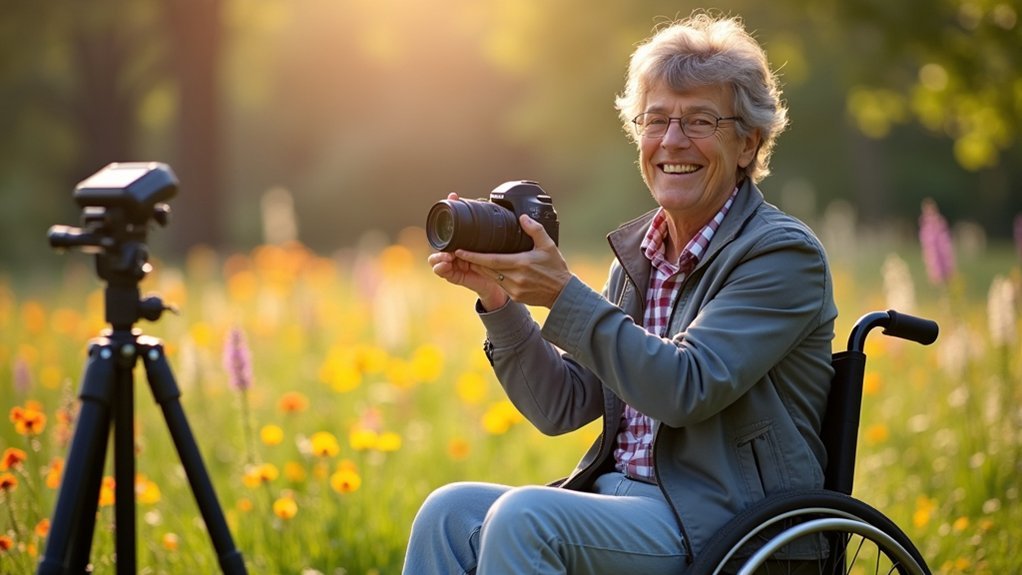
When physical mobility presents challenges, the weight of your camera gear becomes a critical consideration. Mirrorless cameras offer significant advantages, typically weighing just 1-2 pounds compared to DSLRs that often exceed 3 pounds. This weight reduction minimizes strain during extended shooting sessions.
Models like the Fujifilm X-T30 and Olympus OM-D E-M10 Mark III provide robust features while maintaining a lightweight profile. The Sony Cyber-Shot DSC-RX100 series takes portability even further, delivering high-quality images in an ultra-compact form factor.
Beyond just weight, look for ergonomically designed lightweight camera bodies with accessible controls. These thoughtful designs can make a substantial difference if you have reduced hand function, allowing you to operate your equipment more comfortably while still capturing professional-quality images.
Adaptive Camera Grips and Supports for Stability
Securing your camera with flexible mounting solutions like wheelchair-compatible RAM mounts can transform your photography experience by enabling hands-free shooting in diverse environments.
You’ll find one-handed camera controls particularly valuable when managing mobility devices, allowing you to adjust settings and capture images simultaneously without sacrificing stability.
Custom-molded grip systems contoured to your specific hand needs provide exceptional comfort during extended shooting sessions, reducing fatigue and increasing your creative endurance.
Flexible Mounting Solutions
For photographers with disabilities, having reliable ways to mount and stabilize camera equipment can make the difference between capturing the perfect shot and missing it entirely.
Flexible mounting solutions provide innovative ways to secure your gear regardless of mobility challenges.
- RAM mounts offer custom attachment options for wheelchairs, allowing you to position your camera exactly where you need it without hand fatigue.
- JOBY’s GripTight GorillaPod Stand creates versatile support at various angles when traditional setups aren’t practical.
- Monopods serve as excellent stability aids for photographers with limited arm mobility, providing support while maintaining freedom of movement.
- Remote triggers and shutter release timers complement these mounting solutions, letting you capture images without physically pressing the shutter button.
These adaptable systems empower disabled photographers to focus on their creative vision rather than equipment limitations.
One-Handed Camera Controls
Photographers who rely on a single hand to operate their equipment need intuitive, accessible controls that don’t compromise image quality or creative potential.
Adaptive camera grips designed specifically for one-handed operation provide superior control over essential functions while reducing fatigue during extended shoots.
Consider investing in padded straps and ergonomic handles that distribute weight evenly across your arm, minimizing strain on your wrist.
When stability is vital, monopods offer reliable support while freeing your one hand to adjust settings.
Remote shutter releases eliminate the need to press the camera’s physical button, giving you more flexibility in positioning.
For dynamic shooting scenarios, single-handed gimbals provide excellent stabilization while allowing fluid movement.
These specialized tools guarantee you can capture professional-quality images efficiently with one hand without sacrificing creative control.
Custom-Molded Grip Systems
Personalization stands at the core of custom-molded grip systems that transform standard camera equipment into accessible tools for photographers with diverse abilities.
These adaptive supports provide the stability needed for good macro work and extended shooting sessions without causing undue strain.
- Your unique hand shape determines the contours of these ergonomic grips, ensuring maximum comfort and control during operation.
- Textured surfaces and strategic contouring improve security for photographers experiencing tremors or dexterity challenges.
- Lightweight materials prevent adding burden to your gear while maintaining durability and support.
- These customized solutions boost your confidence in handling equipment, allowing you to focus on creative expression rather than struggling with camera control.
With a custom-molded grip system, you’ll spend less time fighting your equipment and more time capturing your artistic vision.
Remote Shutter Controls and Voice-Activated Systems
When physical limitations make pressing a camera’s shutter button challenging, remote controls and voice-activated systems become invaluable tools in a disabled photographer’s arsenal.
Remote shutter controls offer a lightweight, portable solution that eliminates the need to physically touch your camera, reducing strain and camera shake while expanding creative possibilities.
You’ll find wireless options connecting via Bluetooth or infrared particularly useful for maintaining distance from your equipment.
Voice-activated systems integrated into modern cameras and smart devices take accessibility even further, allowing you to capture images through simple verbal commands.
Both technologies empower you to experiment with unique angles and compositions that might otherwise be impossible.
They’re game-changers for photographers with mobility challenges, providing independence and opening new artistic horizons without sacrificing image quality.
Wheelchair-Mountable Camera Equipment
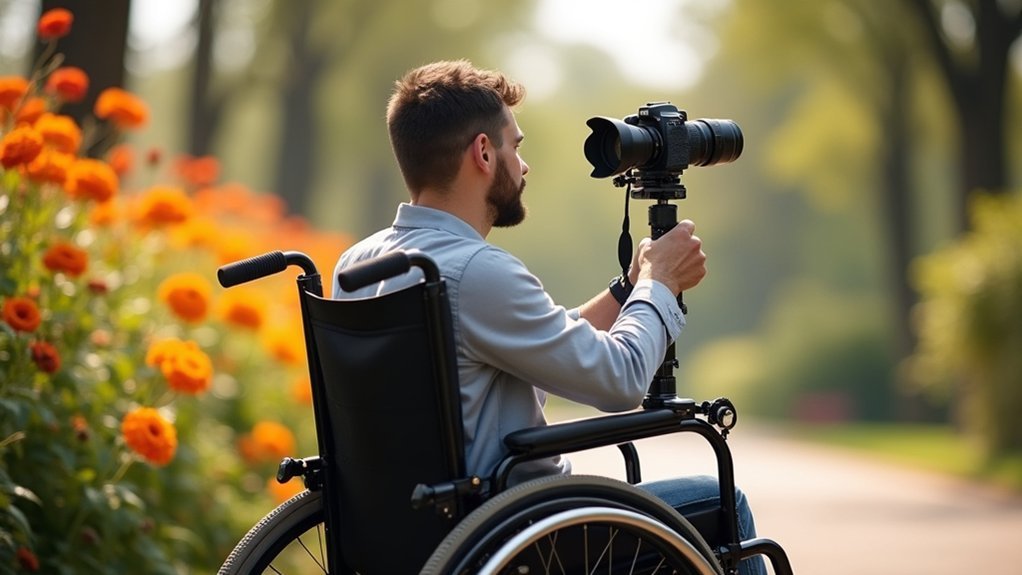
For photographers who use wheelchairs, specialized mounting equipment transforms mobility aids into versatile camera platforms. These solutions enable creativity without compromising stability or access.
- RAM mounts attach securely to wheelchair frames, providing reliable support for cameras while maintaining accessibility and allowing quick position adjustments.
- JOBY GripTight GorillaPod Stands offer flexible positioning options for wheelchair users who prefer adaptable setups for different shooting scenarios.
- Monopod integrations on wheelchair footrests deliver stability for larger lenses without requiring traditional standing positions, making wildlife and sports photography more accessible.
- Drone technology complements wheelchair-mounted equipment by providing aerial perspectives that expand creative possibilities beyond physical limitations.
With these mounting solutions, wheelchair users can participate fully in photography, maintaining independence while capturing professional-quality images from their unique perspectives.
Accessible Tripods and Monopods for Various Mobility Needs
While wheelchair mounts provide excellent on-the-go solutions, many photographers with diverse mobility needs require specialized standing equipment that works with their bodies.
The JOBY GripTight GorillaPod Stand offers impressive versatility, letting you position your camera flexibly for stable handheld shooting.
If you’re working in studio settings, consider the lightweight Square Jellyfish Tripods that provide stability without cumbersome equipment.
For those with limited arm mobility, monopods deliver essential support without the bulk of traditional tripods.
When selecting a tripod, prioritize lightweight models like the Manfrotto 055 or Benro MeFOTO Roadtrip that enhance portability while accommodating your specific shooting style.
Remember that the right support system doesn’t just hold your camera—it extends your creative capabilities regardless of mobility challenges.
One-Handed Operation Tools and Modifications
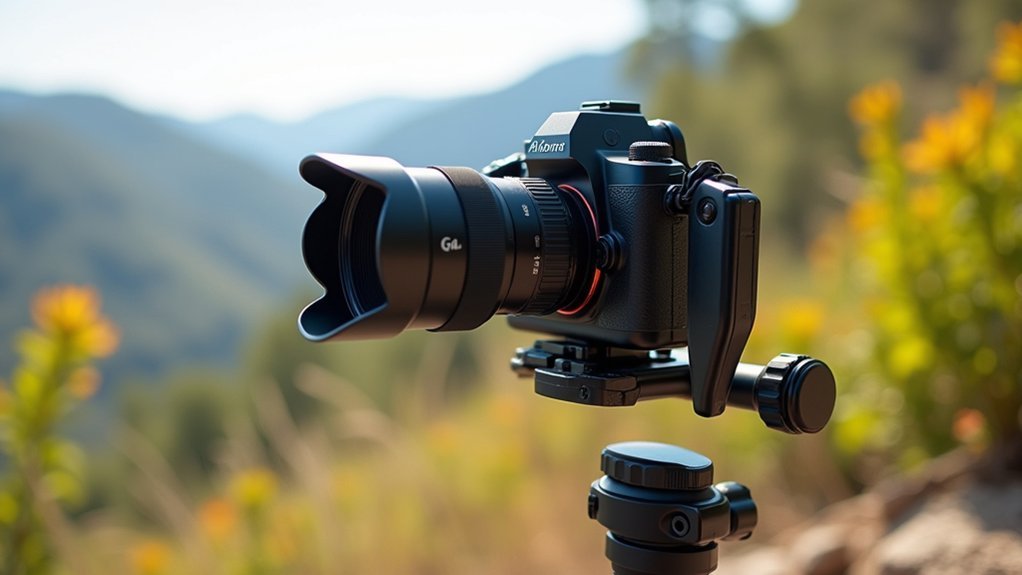
Three essential modifications transform photography for one-handed users: remote triggers, specialized grips, and voice activation systems. These adaptations empower photographers with limited hand function to capture stunning images independently.
- Remote triggers and shutter release buttons allow you to take photos without pressing the camera’s physical shutter, perfect when dexterity is challenging.
- Modified camera grips and straps provide enhanced stability for one-handed operation while reducing wrist strain.
- Wheelchair camera mount solutions utilizing tripods or monopods attached to your mobility device create a stable shooting platform.
- Voice-activated features on modern cameras enable completely hands-free operation when manual controls aren’t practical.
Look for ergonomic camera designs with accessible control layouts that place essential functions within easy reach, further simplifying one-handed photography.
Camera Apps With Accessibility Features
Beyond physical adaptations, smartphone camera apps offer powerful accessibility features that expand photography possibilities for disabled photographers. You’ll find tools designed specifically to overcome various challenges through voice control, customizable interfaces, and hands-free operation.
| App | Key Accessibility Feature |
|---|---|
| ProCamera (iOS) | Voice-activated shutter release |
| Camera+ (iOS) | High-contrast interface options |
| Android Camera | Compatible with accessibility services |
| Adobe Lightroom | Adjustable text sizes and layouts |
| Snapseed | Customizable color contrast settings |
These camera apps with accessibility features allow you to personalize your photography experience based on your specific needs. Whether you’re using voice commands to capture images hands-free or adjusting interface elements for better visibility, these technological adaptations guarantee that photography remains accessible regardless of physical limitations.
Specialized Carrying Solutions for Mobility Aid Users
For photographers who use mobility aids, transporting camera equipment presents unique challenges that standard carrying cases don’t adequately address. Specialized backpacks like the Lowepro Flipside AW400 and AW500 offer accessible storage designed with your mobility needs in mind.
- Consider lightweight tripods such as the Three Legged Thing Travis or Manfrotto 055 that provide stability without adding unnecessary weight to your gear collection.
- Attach monopods directly to your wheelchair or mobility aid for enhanced camera stabilization while maintaining maneuverability.
- Look for padded straps and ergonomic solutions that distribute weight evenly, reducing physical strain when carrying equipment.
- Explore camera harnesses or vests that enable hands-free transport, allowing you to navigate with your mobility aid while keeping gear secure and accessible.
Drones and Remote Viewing Systems for Alternative Perspectives
Drones offer you unprecedented freedom to capture aerial shots despite mobility constraints, effectively eliminating height limitations that might otherwise restrict your photography.
With remote viewing systems, you’ll see exactly what your camera captures in real-time, allowing you to compose perfect shots from a comfortable position.
These lightweight, stabilized flying cameras put creative control back in your hands through intuitive remote controls, opening up entirely new photographic possibilities you couldn’t otherwise explore.
Overcoming Height Limitations
How can photographers with mobility challenges capture perspectives that require climbing, standing, or reaching elevated positions? Drones offer a revolutionary solution by eliminating physical barriers to creativity.
You’ll gain access to viewpoints that were previously impossible due to mobility limitations.
- Aerial freedom – Control your drone from a comfortable position while exploring vast landscapes and architectural features from above.
- Live viewfinders – See exactly what your drone camera captures in real-time through remote viewing systems on your mobile device.
- Accessible controls – Operate your drone using user-friendly remote controls designed for photographers with limited hand function.
- Stabilized imagery – Capture crisp, professional photos thanks to advanced stabilization features that compensate for wind and movement.
Remote Control Capabilities
Remote control capabilities represent a game-changer for photographers with disabilities, extending far beyond just drone operation.
You’ll find these technologies offer unprecedented creative freedom without physical strain.
Modern drones provide intuitive interfaces through mobile devices, making them accessible even if you have limited hand function.
Many models now feature voice commands and touchscreen controls that adapt to your specific needs.
Remote viewing systems let you monitor and compose shots in real-time from a comfortable distance, eliminating the need to position yourself awkwardly near the camera.
You can adjust settings, frame shots, and capture images without physically handling the equipment.
For maximum flexibility, consider drones that can be mounted on mobility aids like wheelchairs, allowing you to capture dynamic aerial perspectives while maintaining your independence and mobility.
Eyepiece Adapters and Viewfinder Enhancements
While framing the perfect shot can be challenging for anyone, photographers with disabilities often face additional barriers when using standard camera viewfinders. Eyepiece adapters can transform your shooting experience by providing customized access to your camera’s viewfinder.
- If you have limited hand mobility, specialized eyepiece adapters modify your viewfinder’s position, making it easier to access without straining.
- For vision impairments, consider magnifying eyepieces that provide larger, clearer images when framing your shots.
- You’ll find adjustable eyepieces allow for personalized distance settings, ensuring comfortable viewing regardless of your specific needs.
- Electronic viewfinders offer additional benefits with their customizable displays, featuring larger fonts and high-contrast options for enhanced visibility.
Using an eyepiece extender can also help you maintain steady positioning, reducing arm and hand strain during extended photography sessions.
Custom Camera Rigs for Specific Disabilities
Standard photography equipment often falls short for photographers with disabilities, but custom camera rigs can transform impossible scenarios into practical shooting opportunities.
If you’re a wheelchair user, RAM mounts can secure your camera directly to your chair, providing hands-free stability while shooting.
For those with limited hand function, specialized remote triggers operated by mouth or tongue controls let you capture images without pressing traditional buttons.
Consider monopod mounts attached to wheelchair footrests for improved lens management and sharper images.
Software solutions like Capture One enable camera control through laptops, offering alternative ways to adjust settings when dexterity is limited.
Don’t overlook drones as part of your custom camera rigs—they provide unique perspectives and access to otherwise unreachable angles, expanding your creative possibilities regardless of mobility constraints.
All-Terrain Photography Mobility Solutions
You’ll find specialized rugged wheelchair camera mounts essential for securing your equipment while traversing challenging outdoor photography locations.
These mounts attach securely to all-terrain mobility devices, allowing hands-free operation when you’re focusing on composition rather than equipment management.
Off-road tripod solutions complement these setups with adjustable height features and terrain-adapting legs that stabilize your camera on uneven surfaces, ensuring sharp images even in remote settings.
Rugged Wheelchair Camera Mounts
For photographers who use wheelchairs, exploring rugged terrain no longer means sacrificing your ability to capture stunning images.
Rugged wheelchair camera mounts provide the stability and accessibility you need to pursue your passion across diverse landscapes.
These specialized mounts offer:
- All-terrain stability – RAM mounts and similar systems secure your DSLR or compact camera while maneuvering uneven surfaces.
- Adjustable positioning – Change your camera’s angle and height without physical strain, revealing creative perspectives.
- Immediate access – Keep your gear ready for spontaneous shots without needing additional support.
- Versatile compatibility – Attach virtually any camera type to your wheelchair, ensuring you’ll never miss the perfect moment.
With these mounts, you’ll maintain mobility while having your equipment perfectly positioned for whatever environment you choose to photograph.
Off-Road Tripod Solutions
When traditional tripods fail on challenging terrain, specialized off-road tripod solutions open new creative possibilities for disabled photographers.
Models like the Manfrotto BeFree Advanced and Benro Mach3 combine lightweight materials with durability, making them easier to transport and manipulate.
You’ll appreciate the adjustable legs that stabilize on uneven surfaces, allowing for steady shots in locations previously inaccessible.
The quick-release plates are particularly valuable if you have limited hand function, enabling fast camera attachment and detachment without struggle.
Look for off-road tripods with interchangeable feet—rubber grips for slippery surfaces and spikes for soft ground like sand or mud.
For enhanced mobility, consider adaptive accessories that mount directly to your wheelchair or mobility scooter, providing stability while you navigate diverse landscapes without compromising your creative vision.
Digital Editing Software With Adaptive Interfaces
Although traditional photo editing software often presents barriers for disabled photographers, today’s digital editing landscape has evolved to include a range of adaptive interfaces.
Modern digital editing software now offers customizable features that make post-processing accessible regardless of your specific needs.
- Programs like Adobe Lightroom and Photoshop allow you to customize layouts and tool placement, creating a workspace that accommodates your unique requirements.
- Touch-based apps such as Snapseed provide intuitive interfaces that work well if you have limited hand function or mobility challenges.
- Voice control integration through software like Dragon NaturallySpeaking enables hands-free editing commands.
- Features including keyboard shortcuts, screen magnification, and high-contrast modes make editing more accessible for photographers with dexterity limitations or visual impairments.
Frequently Asked Questions
What Is the 20-60-20 Rule in Photography?
The 20-60-20 rule suggests you’ll create a balanced portfolio by shooting 20% with wide-angle lenses, 60% with standard lenses, and 20% with telephoto lenses. It encourages you to explore diverse perspectives in your photography.
What Do Photographers Struggle With the Most?
You’ll find most photographers struggle with achieving consistent lighting, mastering technical settings, developing a unique style, and finding time to practice. Self-doubt and comparison to others also frequently diminish creative confidence.
How Much Does Professional Photography Equipment Cost?
You’ll spend $1,000-$5,000 for a professional camera and lens, plus $500-$2,000 for lighting, tripods, and accessories. Don’t forget $10-$50 monthly for editing software subscriptions. It’s a significant investment.
What Made Photography More Accessible?
You’ve seen photography become more accessible through smartphone cameras, affordable entry-level DSLRs, free editing apps, YouTube tutorials, and social media platforms that let anyone share their work without professional gatekeeping.
In Summary
With the right gear, you’ll find that photography has no boundaries. Whether it’s lightweight cameras, adaptive grips, or voice-controlled shutters, there’s equipment designed for your specific needs. Don’t let physical limitations stop you from capturing stunning images. Explore these accessibility options, adapt them to your situation, and you’ll discover that the art of photography remains within your reach, ready for your unique perspective.

Leave a Reply