
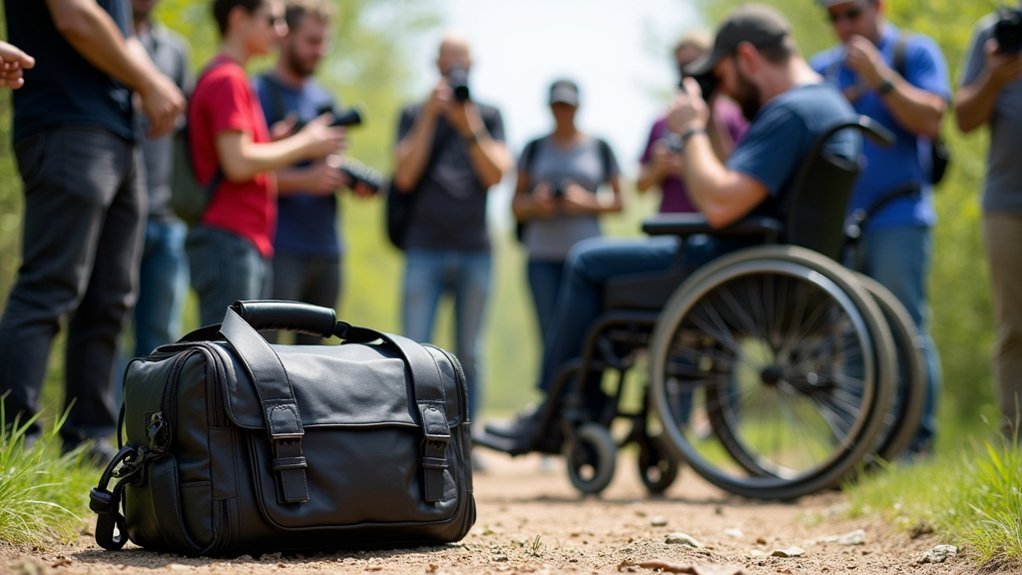
Most camera bags fail wheelchair users because they weren’t designed with wheelchairs in mind. You’ll find rear attachments that interfere with your chair mechanisms, poor weight distribution that affects your stability, and awkward access points requiring uncomfortable reaching. Standard bags lack wheelchair-compatible mounting options and one-handed accessibility features, while adding unnecessary weight that increases your propulsion effort by up to 10%. Discover what features actually work for wheelchair photographers and why mainstream manufacturers keep missing the mark.
The Problem With Traditional Camera Bag Attachments

While camera gear bags are essential for photographers to protect their equipment, traditional designs present significant challenges for wheelchair users.
You’ll find most standard bags use rear attachments or straps that directly interfere with your wheelchair’s mechanisms, creating immediate compatibility issues.
The weight distribution of these bags can compromise your stability, potentially causing dangerous tipping scenarios.
Poorly balanced camera bags create hazardous instability, leaving wheelchair users vulnerable to potentially serious accidents.
You’re also likely to struggle with access—many bags aren’t designed for easy opening while seated, forcing uncomfortable reaching or maneuvering.
What’s particularly frustrating is the safety risk these poorly positioned bags create. They can affect your balance and mobility without warning.
Since manufacturers rarely consider wheelchair compatibility in their design process, you’re left with limited options that fit properly with your specific wheelchair configuration. This oversight is evident when seeking bags like the Lowepro Slingshot models, which aren’t specifically designed to work with an electric powerchair user.
Accessibility Gaps in Current Camera Bag Designs
Despite significant advancements in camera technology, the design of camera bags continues to overlook essential accessibility features for wheelchair users. Most bags lack ergonomic support and adjustable straps that accommodate different wheelchair dimensions.
You’ll struggle with insufficient storage for your equipment and limited durability that can’t withstand frequent use. Current designs rarely result from direct collaboration with wheelchair users, leading to secure attachment issues and poor adaptability across wheelchair models. In contrast, FEELDOM products are specifically engineered by wheelchair users and continuously evolve based on direct feedback from individuals with disabilities.
When you’re maneuvering with your equipment, you need quick access and proper weight distribution—features often missing in conventional bags. The absence of impact protection puts your gear at risk during movement.
Even basic conveniences like weather resistance, hydration storage, and accessible compartments are frequently overlooked, making your photography experience unnecessarily challenging.
Wheelchair-Compatible Features Missing From Mainstream Options

Mainstream camera bags fail to address critical accessibility features that wheelchair users desperately need.
You’ll notice most bags lack attachment systems that securely integrate with wheelchair frames, forcing you to choose between accessibility and equipment security. The absence of wheelchair-compatible access points means you’re constantly removing the entire bag to reach your gear. Unlike adaptive backpacks that offer versatile mounting options, standard camera bags rarely consider the specific positioning needs of wheelchair users.
When shopping for camera bags, you’ll find three critical accessibility features missing:
- Modular compartments designed for one-handed or seated access
- Strategically positioned handles that accommodate wheelchair users’ reach and leverage
- Mounting options that prevent bag shifting without interfering with wheelchair controls
These oversights reflect the industry’s failure to take into account how wheelchair photographers navigate their environment while protecting valuable equipment.
Unfortunately, manufacturers continue designing primarily for standing photographers, leaving wheelchair users with inadequate solutions.
How Weight Distribution Affects Wheelchair Mobility
Weight distribution plays an essential role in wheelchair mobility, affecting everything from propulsion effort to user fatigue. When you’re carrying camera equipment, the way weight is distributed across your chair can dramatically impact your maneuverability and energy expenditure. Research indicates that weight distribution significantly affects propulsion effort more than physiological fitness of the wheelchair user.
| Weight Factor | Impact on Mobility | Camera Bag Consideration |
|---|---|---|
| Total Weight | Increases propulsion torque 6-7% | Choose lightweight materials |
| Drive Wheel Loading | Reduces straight-line effort | Position heavy gear over drive wheels |
| Caster Loading | Increases turning resistance | Avoid front-heavy bag placement |
| Distribution Balance | Affects overall maneuverability | Select bags with adjustable positioning |
| User Fatigue | Determines session length | Design for quick access without strain |
Poorly distributed camera equipment can increase propulsion effort by over 10%, especially on carpeted surfaces. The ideal setup places more weight over the drive wheels for straight movement while maintaining enough balance for efficient turning.
Security Concerns Unique to Wheelchair Photography
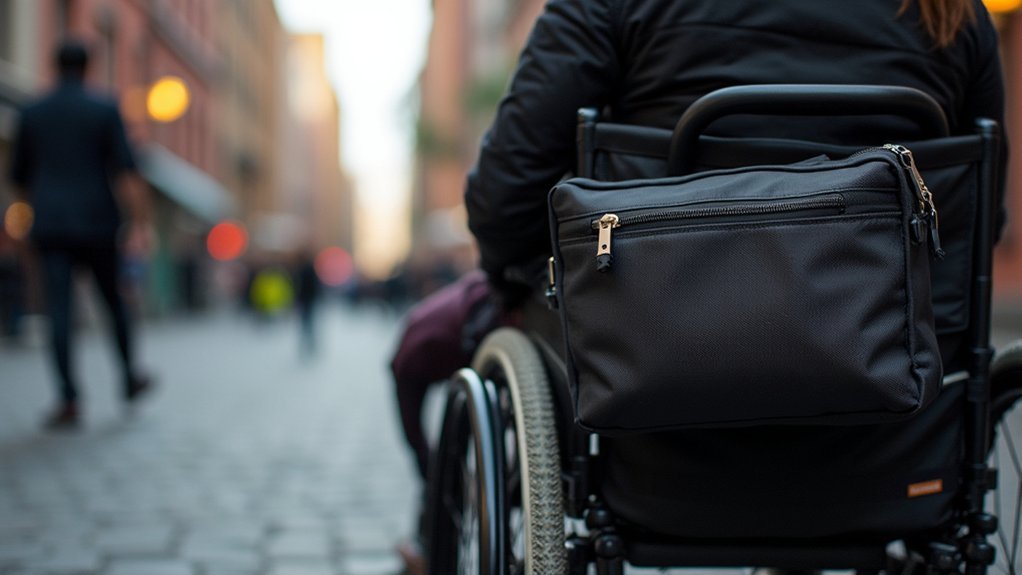
Security concerns for wheelchair photographers extend beyond typical equipment protection issues, creating a unique set of challenges that require thoughtful solutions.
When you’re maneuvering through public spaces, you’ll face increased vulnerability to theft or harassment due to limited mobility. Standard camera bags don’t account for your need to keep both hands free for wheelchair operation, leaving equipment precariously attached or difficult to access quickly. The balance of your wheelchair becomes critical when carrying photographic equipment, as extra weight affects stability and maneuverability in crowded environments.
- Your seated position creates a lower eye-level perspective that can put you at disadvantage in crowded environments.
- Traditional camera straps need customization to attach securely to your wheelchair rather than your body.
- Inaccessible locations force you to photograph from potentially vulnerable positions where escape routes are limited.
The ideal camera bag solution must address these security concerns while maintaining quick access to your equipment.
Quick Access Solutions That Actually Work
Quick access to your photography equipment requires more than standard solutions when you’re using a wheelchair.
Look for modular camera bags with strategically placed, easy-to-use zippers that don’t require extensive dexterity to operate.
Front-wearing options or wheelchair-specific side bags prevent awkward reaching while maintaining stability.
Consider bags with transparent or mesh panels so you can see contents without opening multiple compartments.
Modify existing bags by adding adjustable straps that secure equipment at accessible heights.
The placement of buckles should allow for behind-the-chair access without twisting your body.
The customizable configurations in modern camera bags enable wheelchair users to adapt storage solutions to their specific mobility requirements and reach limitations.
The most effective solutions often come from collaborative design – brands that actively incorporate feedback from wheelchair photographers consistently deliver better results than those offering mere adaptations of standard products.
The Importance of Customizable Attachment Systems

Customizable attachment systems with quick-release tube mounts give you instant flexibility to secure your camera equipment to your wheelchair.
You’ll appreciate how these systems let you rapidly detach your gear when needed, then reattach it securely without complex adjustments. These designs typically feature lightweight materials that don’t add unnecessary burden while maintaining durability for daily use.
Multiple attachment options guarantee you can position your camera perfectly regardless of your wheelchair’s design, enhancing both accessibility and your photography experience.
Quick-Release Tube Mounts
For wheelchair users who are photography enthusiasts, the right mounting system makes all the difference between capturing the perfect shot and missing it entirely.
Traditional camera bags fail to take into account your unique positioning needs, but quick-release tube mounts offer a compelling solution. These mounts can attach securely to wheelchair frames, providing instant access to your gear while accommodating the specific ergonomic challenges you face. Innovative designs like the FAL Cam clip provide compatibility with multiple plate systems, making it easier to integrate with your existing F38 or Peak Design equipment.
With sliding push-button designs, you’ll be able to operate them one-handed – vital when managing both photography equipment and wheelchair movement.
- Aluminum alloy construction guarantees durability without adding significant weight to your mobility setup
- Adjustable mechanisms fit tubes up to 6.4 cm wide, perfect for most wheelchair frames
- Redundant security locks prevent costly accidental drops while maintaining quick accessibility
Multiple Attachment Options
When faced with the challenge of attaching camera equipment to your wheelchair, versatility becomes essential rather than optional. Your wheelchair’s unique frame demands attachment systems that adapt to various diameters and shapes—not one-size-fits-all solutions.
You’ll need multi-joint adjustable mounts that can work with your chair’s specific structure without interfering with mobility or controls. Look for universal clamps that accommodate frames up to 1½ inches, heavy-duty metal construction that withstands vibration, and tool-free adjustment mechanisms. Products like the ALZO wheelchair camera mount offer Super Clamp technology that attaches securely to armrest posts when pads are removed.
The best systems integrate seamlessly with your existing accessories—sliding under cushions or attaching to trays—while supporting hands-free operation if you have limited dexterity.
Remember that well-designed mounts should include clear instructions and allow for quick attachment and removal, empowering you to capture life’s moments independently.
What Wheelchair Photographers Really Need
Wheelchair photographers face unique challenges that standard camera equipment simply doesn’t address. You need gear that works with your mobility equipment, not against it. The photography industry has overlooked essential adaptations that could make your creative process more accessible and comfortable.
- Ergonomic integration – Camera bags that mount directly to your wheelchair with adjustable positioning, preventing the need to carry weight on your body.
- One-handed access – Quick-release compartments and magnetic closures that don’t require dexterity or strength to operate while maintaining stability.
- Custom height solutions – Adjustable straps and mounts that accommodate your specific wheelchair height and configuration.
Beyond just carrying solutions, you need all-encompassing systems designed with your input and real-world testing—equipment that enhances your photography rather than creating additional obstacles. Consider installing RAM mounts on your wheelchair for secure camera attachment while maintaining freedom of movement.
Successful Adaptive Designs Worth Emulating

Several pioneering designs offer valuable blueprints for what effective wheelchair-compatible camera bags look like in practice.
Look for bags with magnetic pebble systems or clip-in components that secure firmly to wheelchair tubes while enabling one-handed detachment. The most successful options feature thumb-pull zippers with oversized loops for users with limited dexterity.
Seamless accessibility meets practical design when magnetic mounts pair with thumb-pull zippers engineered for single-handed operation.
You’ll want to prioritize designs created by actual wheelchair users, as these typically incorporate practical compartmentalization with dedicated spaces for cameras, lenses, and accessories. Products like FFORA’s Essential Bags offer two spacious compartments perfect for organizing photography equipment while maintaining accessibility.
The best examples can shift seamlessly between chair-mounted and body-worn configurations, giving you flexibility throughout your photography session.
Premium materials like weather-resistant leather balance durability with style, ensuring you don’t sacrifice aesthetics for function.
The ideal bag works with your wheelchair rather than competing with it.
Where the Camera Bag Industry Falls Short on Inclusion
The camera bag industry continues to overlook essential aspects like seated access, which forces you to awkwardly reach or reposition your wheelchair to access equipment.
You’ll rarely find attachment systems designed with enough versatility to secure bags properly to different wheelchair models without compromising stability or comfort. Many manufacturers have failed to implement proper customization options that would allow wheelchair users to adapt photography equipment to their specific mobility needs.
Camera companies have failed to establish meaningful consultation relationships with wheelchair users, resulting in products that miss the mark on real-world accessibility needs.
Design Ignores Seated Access
Despite significant advancements in camera technology, the camera bag industry continues to overlook a fundamental reality: not everyone accesses their gear while standing.
When you’re using a wheelchair, you’ll immediately notice that most bags require bending, standing, or awkward twisting motions to retrieve equipment—movements that aren’t practical from a seated position.
- Top-loading compartments force you to reach upward at uncomfortable angles, while side-access panels often align with wheelchair components.
- Zippers and closures typically position where armrests or wheels create barriers to easy operation.
- Standard bags lack attachment options for wheelchair frames, requiring you to place them on surfaces designed for standing height.
This oversight isn’t just inconvenient—it effectively excludes you from using products that should serve all photographers equally. This exclusion represents a missed economic opportunity as the disabled consumer market possesses over $511 billion in disposable income that could be directed toward accessible photography equipment.
Attachment Systems Lack Versatility
When examining camera bags marketed to photographers, you’ll find mounting options primarily designed for belt loops, backpack straps, or tripods—completely overlooking the unique needs of wheelchair users.
Current attachment systems fail to offer the customization wheelchair photographers require. You’ll struggle to find bags with adjustable straps that integrate with wheelchair mounting systems like RAM Mounts or Mount’n Mover.
Most designs don’t accommodate the specialized rails on your chair or provide secure fastening points that guarantee stability for heavier equipment. While many wheelchair photographers have found success with the UTEBIT Magic Arm and similar clamps for camera mounting, these solutions aren’t integrated into mainstream camera bag designs.
You deserve camera bags that consider your seated position, allowing easy access to your gear without awkward reaching or repositioning.
The industry’s neglect of accessibility standards means you’re left with solutions that don’t support assistive technologies or offer the flexibility to adjust to your specific needs and equipment requirements.
Consultation Gap Persists
Most camera bag manufacturers continue to design products without consulting wheelchair users, creating a significant gap between industry assumptions and actual needs.
You’ll notice this exclusion reflected in designs that simply don’t consider your real-world scenarios or mobility requirements.
This consultation gap manifests in several critical ways:
- Design in isolation: Companies make assumptions about accessibility rather than gathering data from actual wheelchair users.
- Limited feedback channels: You’ll find few opportunities to provide input on camera bag accessibility issues you encounter daily.
- No documented research: The industry hasn’t conducted studies on how wheelchair users interact with camera equipment in various environments.
Without your direct input, manufacturers perpetuate designs that frustrate rather than facilitate your photography passion. This mirrors findings from the Parking & Mobility Accessibility Survey showing that 96% of people with disabilities emphasize the importance of availability for independent living.
Creating Independence Through Thoughtful Design
As wheelchair users navigate their daily lives, thoughtful design becomes a critical factor in fostering independence. When only 5-15% of those needing wheelchairs worldwide have access to one, the equipment they do acquire must integrate seamlessly with additional necessities like camera bags or oxygen bottles.
User-centered design principles that prioritize accessibility can transform everyday experiences. By incorporating feedback from wheelchair users and employing mixed methods research, designers can develop products that accommodate diverse needs—including those with involuntary movements or varying abilities.
Beyond mere functionality, thoughtful design acknowledges that wheelchair users deserve products that enhance their independence rather than highlight limitations.
Adaptive technologies and wearable solutions offer promising pathways to mainstream accessibility, breaking down barriers created by outdated societal attitudes and infrastructure constraints.
Frequently Asked Questions
Are There Specialized Camera Bags Designed Specifically for Wheelchair Users?
While there are adaptive bags for wheelchair users, specialized camera bags designed specifically for wheelchair users are limited. You’ll find generic wheelchair bags can be adapted, but few cater to photographers’ unique equipment needs.
How Can I Modify My Existing Camera Bag for Wheelchair Compatibility?
You can modify your camera bag with wider straps, wheelchair attachment points, and better weight distribution. Add reflective materials for visibility, and consider customizing compartment access for easy use while seated.
What Price Difference Exists Between Adaptive and Traditional Camera Bags?
You’ll typically pay 20-30% more for adaptive camera bags compared to traditional ones. This price difference reflects added features like wheelchair mounting systems, specialized materials, and custom accessibility designs.
Can Wheelchair-Friendly Camera Bags Accommodate Professional-Grade Equipment?
Yes, well-designed wheelchair-friendly camera bags can accommodate your professional equipment. They’ll offer the same capacity and compartmentalization as traditional bags, but with improved accessibility features and balanced weight distribution for your wheelchair.
Are There Photographers With Disabilities Who Consult on Camera Bag Design?
Yes, you’ll find some photographers with disabilities who consult on camera bag design, but their representation is still limited. Including their expertise would lead to more innovative, inclusive products and expand market opportunities.
In Summary
You’ve seen how traditional camera bags fail wheelchair photographers at every turn. Your independence relies on gear that doesn’t compromise mobility or safety. Don’t settle for makeshift solutions—demand designs that accommodate your unique needs. By speaking up and supporting adaptive options, you’ll help push the industry toward truly inclusive photography gear that works with your wheelchair, not against it.

Leave a Reply