
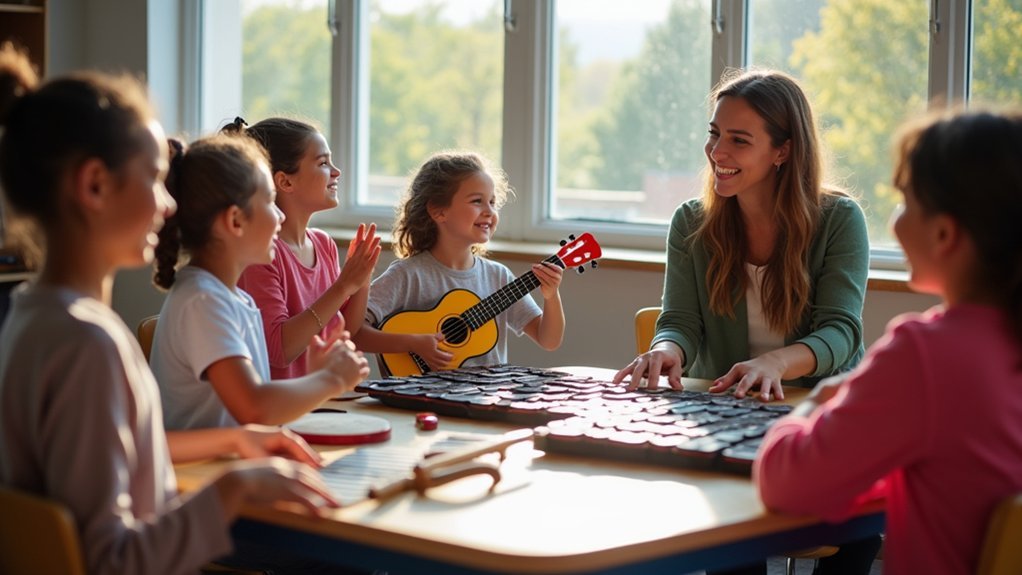
Inclusive instruments like CMPSR with its velocity-sensitive joystick, Odd Ball for movement-based learning, and sensory-friendly options like Tongue Drums transform music classrooms. Digital tools eliminate barriers while adaptable grip options and adjustable heights accommodate wheelchair users. Look for lightweight materials, simplified playing mechanisms, and tactile elements to support diverse abilities. These innovations create environments where all students can participate, regardless of physical limitations or sensory needs. The world of accessible music education continues to expand in remarkable ways.
What Inclusive Instruments Transform Music Education Classrooms?
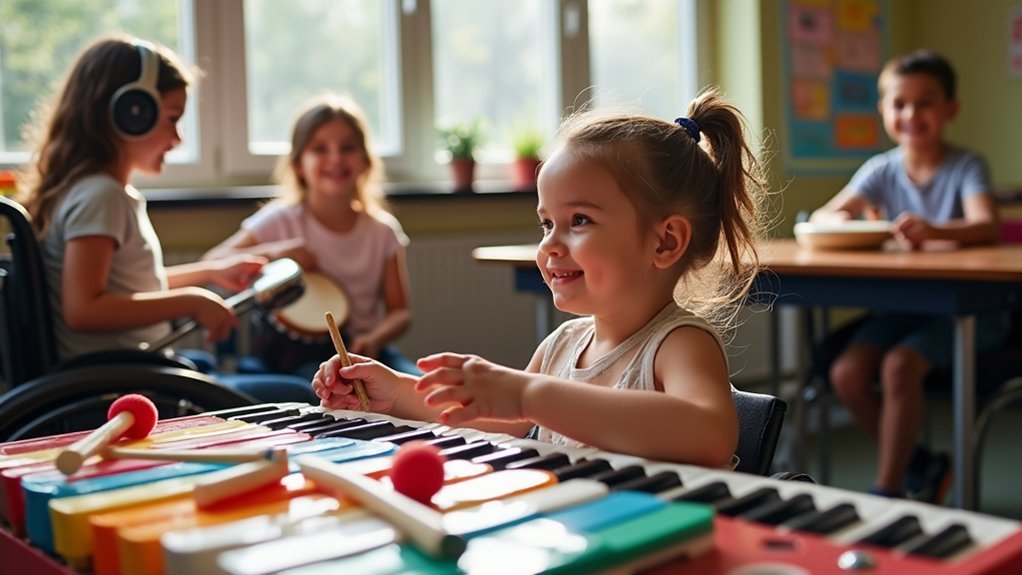
While traditional music education often relies on conventional instruments that can pose barriers for some students, today’s inclusive classrooms embrace innovative tools designed for universal participation.
Specialized tools like CMPSR with its velocity-sensitive joystick and Cosmo Excel with educator-designed activities transform music education in schools by making creation accessible to students with special needs.
The dynamic Odd Ball encourages engaging with music through movement, perfect for kinesthetic learners.
For those with sensory sensitivities, the gentle Tongue Drum and Ocean Drum provide adaptive alternatives to louder instruments.
Portable options like the 3rd Avenue Roll-Up Drum Kit and A-Star Handheld Percussion guarantee that physical limitations don’t prevent participation.
These innovations create truly inclusive music classrooms where every student can express themselves creatively.
The Impact of Digital Instruments on Student Engagement
As classrooms evolve beyond traditional music education approaches, digital instruments are revolutionizing how students engage with musical concepts. Innovations like the CMPSR with its intuitive joystick mechanism and the Cosmo Excel with over 35 interactive apps demonstrate how adaptive technology creates accessible entry points for all learners, regardless of ability.
You’ll find that these digital tools remove barriers to music creation by simplifying complex musical concepts. The CMPSR’s keyboard zones guarantee students can produce harmonious sounds without extensive training, while platforms like GarageBand and Soundtrap encourage experimentation and collaboration.
Research confirms what educators are witnessing firsthand: schools that incorporate these technologies report significant increases in student engagement with composition and performance, making music education more inclusive and motivating for diverse learners.
CMPSR: Making Music Creation Accessible to All Abilities
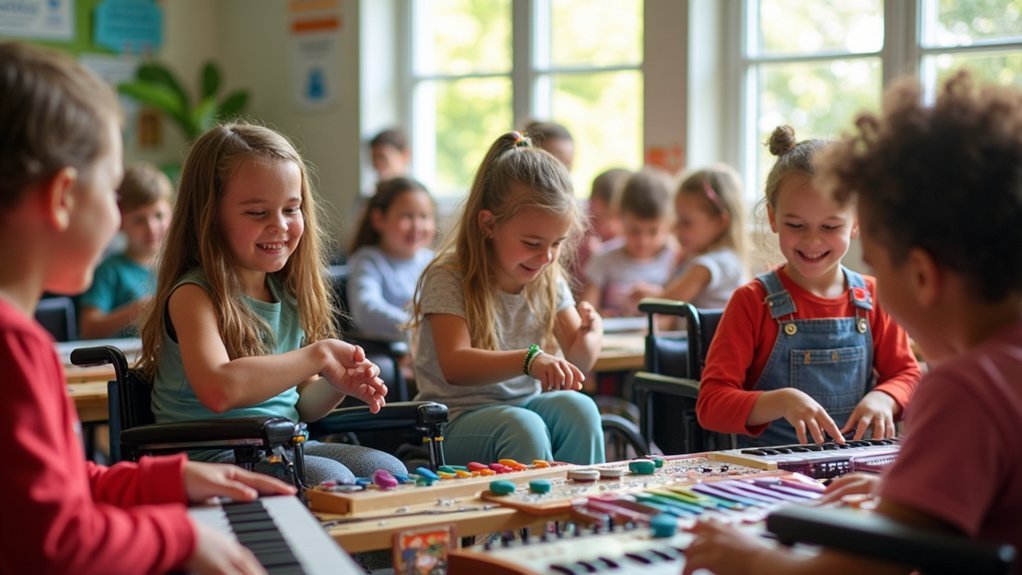
The CMPSR stands at the forefront of inclusive digital instruments, exemplifying how thoughtful design can democratize music creation. By condensing a piano into a velocity-sensitive joystick with eight distinct zones, you’ll find music education transformed into an accessible experience where all students can participate regardless of prior training.
- The always-in-key function eliminates barriers to harmony creation, making music accessible to students with varying abilities.
- Its intuitive joystick design provides students with Special Educational Needs and Disabilities (SEND) meaningful pathways to creative expression.
- Compatibility with various music apps expands learning opportunities, ensuring every student can engage in authentic music creation.
This innovative instrument bridges ability gaps, ensuring music-making becomes a universal language in diverse classrooms.
Sensory-Friendly Percussion Options for Diverse Learners
You’ll find that instruments with gentle sounds like the Tongue Drum and Ocean Drum create accessible entry points for students who experience sound sensitivity in music classrooms.
These mellow-toned options allow learners to engage comfortably with percussion without triggering sensory overload.
For students who thrive with kinesthetic learning approaches, the 3rd Avenue Soft Touch Roll-Up Drum Kit and Odd Ball offer movement-based rhythm exploration that connects physical activity with musical expression.
Gentle Sounds Matter
Music classrooms filled with crashing cymbals and booming drums can overwhelm students with sensory sensitivities, creating barriers to participation rather than pathways to expression.
When you introduce gentle sounds through adaptive instruments like the Ocean Drum and Tongue Drum, you’re supporting sensory development while maintaining an inclusive atmosphere where all students can thrive.
These sensory-friendly options transform music education by:
- Providing calming sonic experiences that welcome rather than overwhelm sensitive learners
- Enabling collaborative music-making through instruments like the A-Star Gathering Drum that foster community
- Offering accessible designs with soft-touch surfaces that accommodate varying physical abilities
Movement-Based Rhythm Exploration
Movement and rhythm intertwine naturally, creating powerful learning opportunities for students across the sensory spectrum. The Odd Ball offers innovative movement-based rhythm exploration, connecting to mobile apps that transform physical gestures into sound, making rhythm accessible to diverse learners.
| Instrument | Benefits for Diverse Learners |
|---|---|
| Odd Ball | Translates movement into sound patterns |
| 3rd Avenue Roll-Up Drum Kit | Responds to light touches for inclusive participation |
| Ocean Drum | Provides soothing sensory exploration for sound-sensitive students |
For thorough learning, incorporate multi-sensory approaches with color-coded instruments and visual aids. A-Star Handheld Percussion instruments foster community building through collective music-making. These tools create an environment where all students, regardless of ability level, can physically engage with rhythm through personalized sensory exploration.
Movement-Based Musical Tools for Kinesthetic Learning
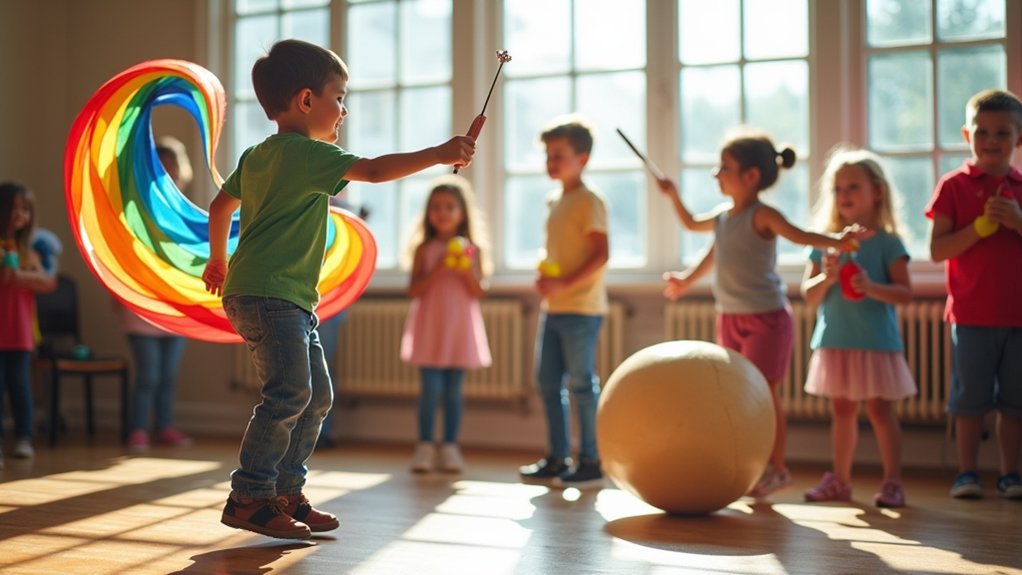
Motion-activated expression techniques transform your students’ natural movements into musical experiences, creating accessible entry points for those who learn best through physical engagement.
You’ll find that incorporating rhythmic movement games helps students internalize musical concepts while simultaneously developing their gross motor skills and coordination.
These kinesthetic approaches don’t just make music more inclusive—they reveal new creative pathways for students who might struggle with traditional instrument playing.
Motion-Activated Expression Techniques
As students with diverse learning styles fill today’s classrooms, innovative motion-activated expression techniques have emerged as powerful tools for inclusive music education. Tools like the Odd Ball connect physical movement directly to sound production, creating a dynamic learning environment where kinesthetic learners thrive.
You’ll notice increased engagement as students explore music through motion rather than traditional static instruments.
- Movement-based instruments respond to physical actions, allowing students with sensory processing challenges to participate fully in musical creation.
- Mobile app integration enables real-time sound production that adapts to each student’s unique movements and abilities.
- Physical rhythmic exercises develop musical understanding while simultaneously supporting students who benefit from active learning approaches.
These techniques transform ordinary classrooms into spaces where creativity flourishes through movement-activated musical expression.
Rhythmic Movement Games
Rhythmic movement games take motion-activated techniques to the next level by creating structured play experiences that transform music education into a full-body activity. You’ll find these kinesthetic learning approaches particularly beneficial for students who struggle with traditional instruction methods.
| Game Type | Benefits |
|---|---|
| Odd Ball Activities | Enhances coordination while making music |
| Roll-Up Drum Kits | Provides accessible options for all abilities |
| Group Synchronization | Improves social skills and teamwork |
| Sensory-Friendly Rhythms | Supports students with processing challenges |
When you incorporate adaptive instruments like the 3rd Avenue Soft Touch Roll-Up Drum Kit, you’re creating an inclusive environment where every student can engage meaningfully. These movement-based tools foster deeper musical understanding through physical engagement, allowing learners to literally feel the rhythm while developing essential motor skills.
Adaptive Technology: Bridging Musical Gaps in the Classroom
While traditional instruments often require years of technical training, adaptive technology has revolutionized music education by creating accessible pathways for all students. Tools like CMPSR transform any device into an inclusive instrument through velocity-sensitive joysticks, enabling students of all abilities to engage with music creatively.
- Intuitive Design – Instruments like Cosmo Excel feature smart buttons and guided activities, making music education accessible regardless of prior experience or physical ability.
- Sensory Accommodation – Ocean Drums and Tongue Drums provide soothing sounds for students with sensory sensitivities.
- Physical Adaptation – Movement-based options like Odd Ball and soft-touch percussion instruments accommodate different learning styles and physical capabilities.
These adaptive technologies guarantee all students can participate fully in music education through personalized sensory exploration.
The Role of Soft-Touch Instruments in SEND Education
Soft-touch instruments have emerged as a transformative force in Special Educational Needs and Disabilities (SEND) education, expanding the innovative solutions offered by adaptive technology.
Products like the 3rd Avenue Roll-Up Drum Kit feature lightweight, responsive surfaces that respond to even the lightest touch, making music accessible for students with limited motor control or strength.
You’ll find these instruments particularly valuable for inclusive participation, as their ergonomic design accommodates diverse physical abilities.
Ocean Drums and Tongue Drums offer mellow, soothing sounds ideal for sensory exploration without overwhelming students sensitive to loud noises.
Designing Ergonomic Instruments for Physical Accessibility
When you’re equipping your inclusive music classroom, consider instruments with adaptable grip options that accommodate students with different hand strengths and dexterities.
You’ll find that adjustable instrument heights can make a significant difference for wheelchair users or students who need to play from various positions.
Simplified playing mechanisms, such as single-touch activation or modified fingering systems, allow students with limited motor control to participate fully in musical expression without frustration.
Adaptable Grip Options
As educators endeavor for inclusive classrooms, ergonomic instruments with adaptable grip options have become essential tools in music education.
These adaptive instruments feature soft-touch surfaces and customizable grip shapes that accommodate students with physical disabilities, ensuring everyone can participate in music-making activities regardless of hand size or strength.
You’ll find these accessibility features particularly beneficial for developing students’ confidence and motor skills while reducing fatigue during extended playing sessions:
- Lightweight materials combined with ergonomic designs allow for comfortable handling by all ability levels.
- Adjustable heights and positions enable personalized instrument setup for each student’s unique needs.
- Tactile elements like textured grips and color-coding enhance sensory recognition for students with processing challenges.
These thoughtful design elements transform music classrooms into spaces where every student can express themselves creatively without physical limitations.
Instrument Height Adjustments
Beyond grip enhancements, instrument height adjustability represents another fundamental dimension of accessible music education. When you incorporate ergonomic instruments with adjustable features, you’ll create an environment where all students can actively participate regardless of physical abilities.
| Height Adjustment Feature | Accessibility Benefit |
|---|---|
| Adjustable keyboard stands | Accommodates wheelchair users |
| Modular drum kit setups | Customizable for varying heights |
| Tilting music stands | Improves visibility for all positions |
| Portable lightweight options | Enables independent adjustments |
Customizable instrument designs with interchangeable components allow your students to personalize their setup based on individual needs. The 3rd Avenue Soft Touch Roll-Up Drum Kit exemplifies this approach, offering physical accessibility through its lightweight, adaptable design. Height-adjustable features not only improve comfort but enhance learning experiences by removing barriers to participation and reducing physical strain.
Simplified Playing Mechanisms
The heart of accessible music education lies in simplified playing mechanisms that transform traditional instruments into inclusive tools for creative expression. You’ll find that instruments with adaptive designs like CMPSR’s velocity-sensitive joystick enable students with varying abilities to play notes and chords effortlessly, without requiring traditional training.
- Soft-touch surfaces respond to light taps, accommodating students with limited motor skills while creating an inclusive environment for sensitive learners.
- Systems like Arrownotes help students shift from basic to advanced music concepts more intuitively.
- Digital instruments with simplified interfaces allow for creative expression regardless of physical limitations.
These innovations create music education spaces where accessibility isn’t an afterthought but a fundamental design principle, ensuring every student can participate fully in musical discovery.
Visual Learning Systems: Arrownotes and Alternative Notation
Visual representations of musical concepts create powerful pathways to understanding for students of all abilities. Arrownotes exemplifies this approach by transforming traditional notation into intuitive arrow directions, making music more accessible through visual learning techniques.
You’ll find this alternative notation system particularly effective for engaging students who might struggle with conventional methods. As they gain confidence, you can guide them toward traditional music notation more smoothly.
Arrownotes aligns perfectly with the National Plan for Music Education’s goal of providing high-quality musical experiences for all learners.
Creating Ensemble Opportunities With Inclusive Instruments
When students participate in ensemble music-making, they develop essential social and musical skills that extend far beyond individual practice.
Instruments like the CMPSR Digital Instrument and A-Star Gathering Drum create pathways for all students, including those with Special Educational Needs and Disabilities (SEND), to engage meaningfully in group performances.
You’ll find that inclusive instruments foster:
- Authentic collaboration – Multi-sensory approaches with ergonomically designed instruments facilitate communication between ensemble members.
- Physical engagement – Tools like the Odd Ball merge movement with music, creating dynamic group experiences.
- Diverse musical expression – Accessible instruments enable all students to contribute their unique voices to the ensemble.
These ensemble opportunities don’t just support SEND students—they enrich everyone’s learning experience, promoting a truly inclusive musical community where all can participate.
Technology-Enhanced Music Making for Diverse Classrooms
Building on the power of ensemble experiences, today’s music classrooms now benefit from revolutionary technology that transforms how students engage with sound.
Technology-enhanced instruments like the CMPSR with its velocity-sensitive joystick make creating music intuitive for students of all abilities.
You’ll find adaptive music tools such as the Cosmo Excel and Odd Ball encourage participation through movement and interactive play.
Digital platforms like GarageBand and Soundtrap enable collaborative music creation without requiring traditional training, while AI-driven systems provide real-time feedback tailored to individual needs.
The soft-touch surfaces of instruments like the 3rd Avenue Roll-Up Drum Kit accommodate diverse physical abilities, making music production accessible to everyone.
These innovations guarantee your classroom becomes a space where all students can express themselves musically, regardless of their abilities.
Portable and Adjustable Instruments for Varied Physical Needs
The versatility of portable and adjustable instruments opens doors for students with diverse physical needs to fully participate in music-making experiences.
Accessible instruments create musical opportunities where physical limitations once presented barriers
You’ll find options like the 3rd Avenue Soft Touch Roll-Up Drum Kit responding to light taps, perfect for students with limited motor skills, while remaining lightweight and easy to store.
- Sensory-adaptive instruments like Ocean Drums and Tongue Drums provide gentle sound production for students sensitive to loud noises.
- Communal instruments such as the A-Star Gathering Drum foster an inclusive environment through group participation.
- Customizable equipment can be modified to accommodate specific physical requirements, ensuring meaningful engagement for all learners.
These portable instruments transform music education by removing physical barriers and creating accessible pathways for creative expression.
Sensory Regulation Through Adaptive Musical Experiences
Music’s power to regulate sensory experiences provides an essential pathway for students with sensory processing challenges to engage meaningfully in educational settings.
When you introduce adaptive instruments like the CMPSR Digital Instrument, you’re offering tactile engagement that promotes emotional stability for learners with sensory sensitivities.
Consider incorporating instruments such as the Ocean Drum, which creates calming sounds that help students self-regulate in overwhelming environments.
Soft-touch percussion options, including the 3rd Avenue Roll-Up Drum Kit, allow rhythm exploration without jarring volume, making music education more accessible for all students.
For kinesthetic learners, movement-based instruments like the Odd Ball combine physical activity with sound production, enhancing sensory regulation.
These thoughtfully designed tools with clear visual layouts support Special Educational Needs and Disabilities (SEND) students in fully participating in musical experiences.
Frequently Asked Questions
Which Instrument Is Best for Learning Music?
The “best” instrument varies by your personal needs. You’ll thrive with adaptive options like CMPSR if you have mobility challenges, or Cosmo Excel for intuitive learning. Choose what matches your abilities and interests.
What Is Inclusion in Music Education?
Inclusion in music education means you’re creating spaces where all students can participate, regardless of their abilities. It’s about adapting teaching methods and instruments so everyone can express themselves musically and feel valued.
What Are Adaptive Instruments Examples?
Adaptive instruments include the CMPSR digital instrument, Cosmo Excel, the Odd Ball for movement-based learning, 3rd Avenue Soft Touch Roll-Up Drum Kit, A-Star Gathering Drum, Ocean Drum, and Arrownotes for simplified music notation.
What Are the Innovations in Music Education?
You’ll find many innovations in music education today: adaptive instruments like CMPSR, interactive tools like Cosmo Excel, collaborative DAWs, immersive VR/AR experiences, and AI-powered feedback systems that personalize your learning journey.
In Summary
You’ve discovered how inclusive instruments revolutionize music education by removing barriers and embracing all learners. From CMPSR’s digital tools to sensory-friendly percussion, you’re now equipped to transform your classroom into a space where every student thrives musically. Remember, when you incorporate these adaptive instruments, you’re not just teaching music—you’re creating a community where diverse abilities become unique strengths in the beautiful symphony of inclusive education.


Leave a Reply