

Making outdoor events accessible for everyone means creating universal access points with stable, wide pathways and adaptive equipment options. You’ll need terrain features like gentle slopes and firm surfaces that accommodate all mobility levels. Train your staff to offer respectful assistance without overhelping, and communicate detailed accessibility information before the event. Don’t forget sensory considerations like quiet zones and tactile pathways. Proper planning transforms your event from merely compliant to genuinely inclusive for all participants.
Creating Universal Access Points for Adaptive Equipment
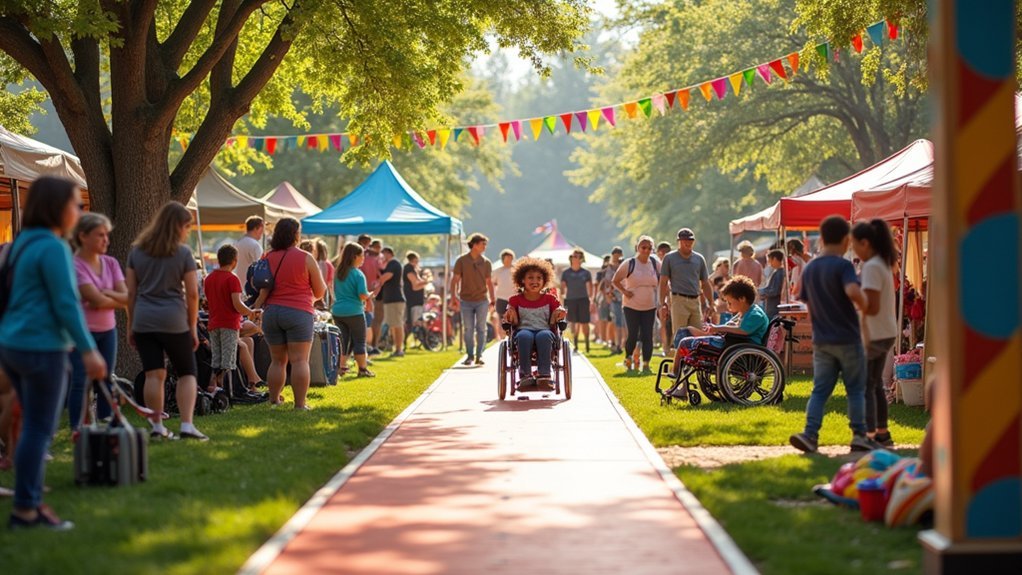
When planning outdoor events, universal access points serve as critical gateways that determine whether all attendees can fully participate.
You’ll need to place these access points strategically throughout your venue, ensuring they meet ADA standards for width, stable surfaces, and navigational ease.
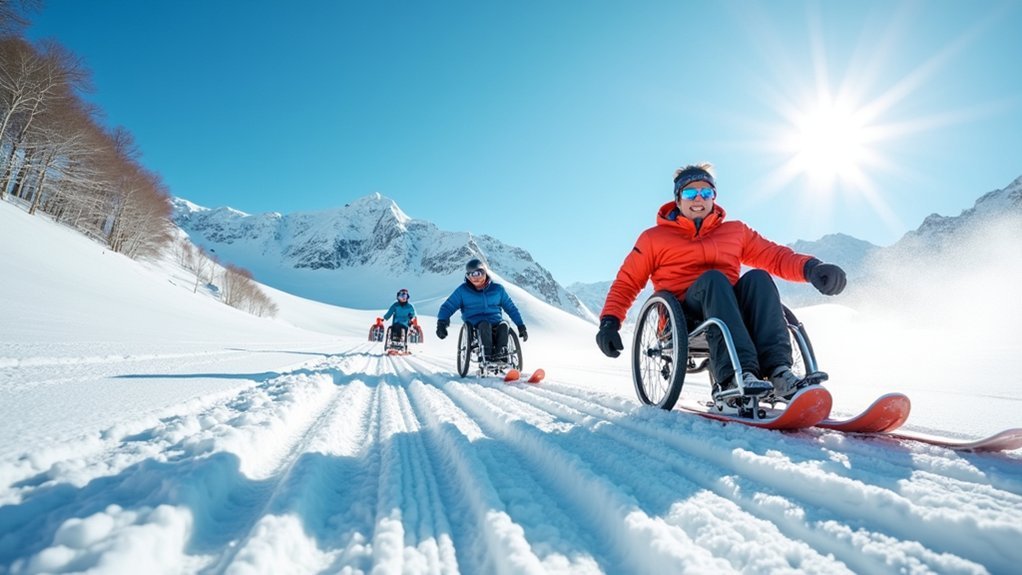
Stock your access points with adaptive equipment like specialized wheelchairs or all-terrain mobility devices to address diverse mobility needs.
Equip access stations with diverse mobility solutions—from all-terrain wheelchairs to specialized devices—ensuring every participant navigates your event with dignity.
Advertise rental options well before your event so attendees can plan accordingly. This simple step can dramatically enhance accessibility for everyone.
Don’t forget to schedule regular maintenance checks of your access points, verifying that ramps remain functional and surfaces stay stable.
Partner with adaptive organizations to leverage their expertise—they’ll help you design access points that effectively serve individuals with disabilities and create a truly inclusive event experience.
Designing Terrain Features That Welcome All Abilities
Though many outdoor event planners focus primarily on programming, the physical terrain of your venue fundamentally determines who can participate comfortably.
Creating inclusive outdoor environments requires thoughtful universal design that accommodates mobility differences.
When designing your venue, make certain you’ve addressed these key terrain features:
- Create accessible trails at least 36 inches wide with firm, stable surfaces that provide seamless wheelchair access.
- Install ramps, handrails, and curb cuts at all elevation changes to eliminate barriers for those with mobility challenges.
- Keep slopes gentle throughout your space, avoiding steep inclines that might exclude participants.
- Position amenities like restrooms and picnic areas strategically to minimize travel distances.
Remember that accessible terrain isn’t just about compliance—it’s about creating outdoor environments where everyone can navigate independently and focus on enjoying your event.
Staff Training for Meaningful Assistance Without Overhelping
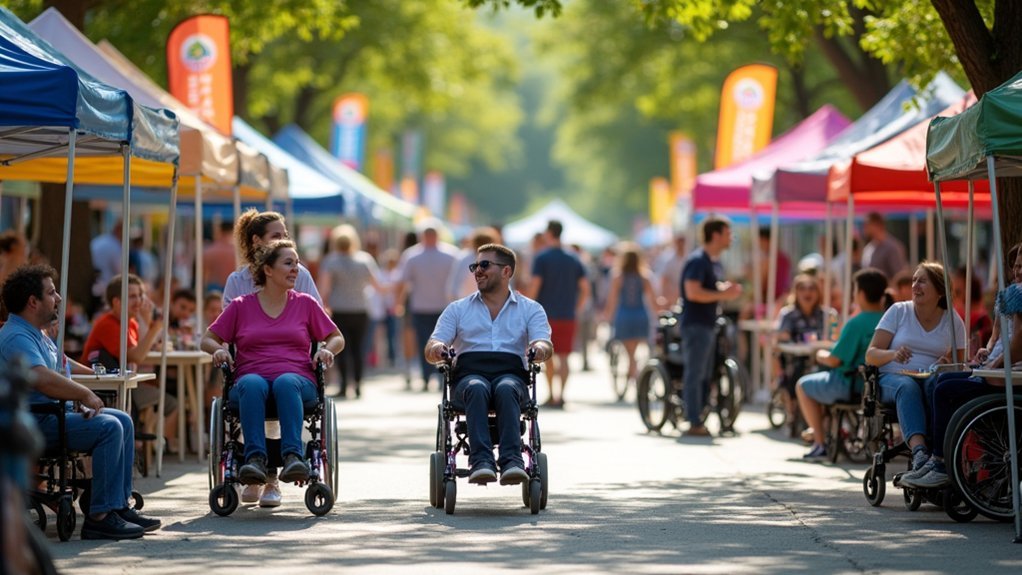
Equip your event staff to recognize varying accommodation needs by providing thorough training on accessibility features, emergency protocols, and person-first language.
You’ll create more inclusive experiences when your team knows how to communicate respectfully, asking “How can I help?” instead of making assumptions about capabilities.
Train staff to respond with appropriate assistance only when requested, balancing their readiness to help with respect for attendees’ independence and agency.
Recognizing Individual Needs
Training staff to recognize individual needs forms the cornerstone of accessible outdoor event planning. Your team must understand that people with disabilities have varying requirements—some need assistance while others prefer independence. Effective training equips staff with ADA knowledge while teaching them to respect attendees’ autonomy.
Event planners should develop training that emphasizes:
- Recognizing different mobility needs without making assumptions about capabilities
- Practicing people-first language that acknowledges the person before their disability
- Understanding accessibility features throughout the venue to provide accurate directions
- Knowing when to offer help versus when to step back and respect independence
Communication Best Practices
Effective communication between staff and attendees with disabilities requires a delicate balance—offering meaningful assistance without overstepping boundaries.
When preparing your accessible event, make certain staff receive thorough training on Americans with Disabilities Act requirements and basic accommodations available throughout your venue.
Train your team to use people-first language and wait for attendees to request help rather than assuming they need assistance. Equip staff with clear information about accessibility features so they can confidently answer questions from people with disabilities.
Include emergency protocols specifically addressing the needs of those with mobility limitations.
Provide visible contact information for accessibility concerns and collect post-event feedback to improve future communications.
Response Without Assumptions
Staff support must strike a balance between helpfulness and respect for independence. Effective training guarantees your team can provide information without making assumptions about attendees’ needs.
Designate an accessibility coordinator who can oversee staff preparation and guarantee compliance with the Americans with Disabilities Act (ADA).
To make outdoor events truly accessible, include these training components:
- Train staff to ask “Would you like assistance?” rather than assuming wheelchair users need help
- Provide venue-specific orientation so team members can confidently direct attendees to accessible features
- Establish clear emergency protocols that respect individual autonomy while guaranteeing safety
- Create feedback mechanisms where attendees can share their experiences to improve future training
This approach empowers your staff to offer meaningful support that respects the dignity and independence of all attendees.
Pre-Event Communication Strategies for Attendees With Disabilities
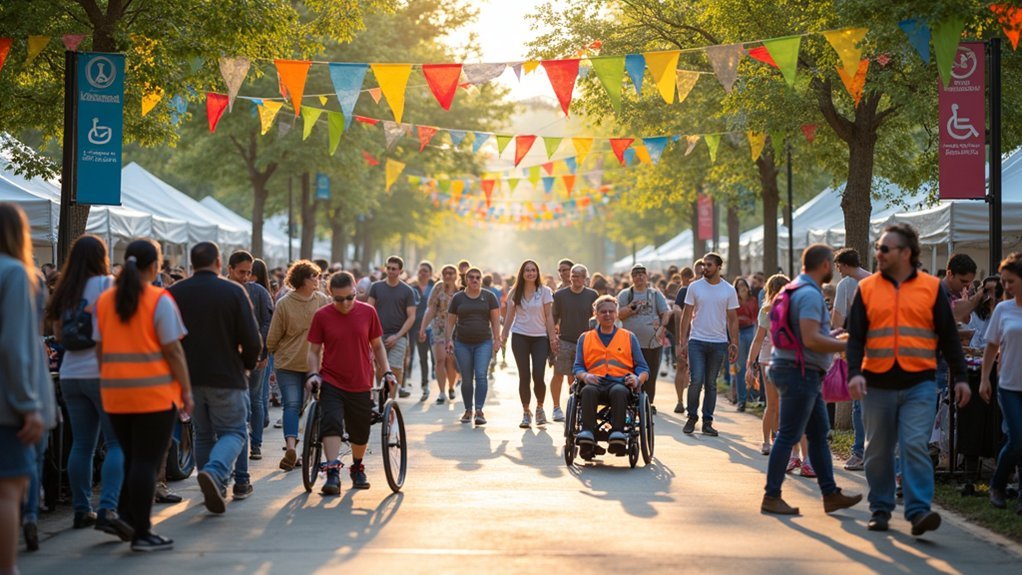
You’ll make your outdoor event truly inclusive by sharing detailed accessibility information about trails, facilities, and adaptive equipment rentals well before attendees arrive.
Offer your essential communications in multiple formats, including braille, large-print, digital versions, and audio recordings to guarantee everyone can access critical information regardless of their disability.
Establish clear contact procedures with a dedicated accessibility coordinator who can answer specific questions and accommodate individual needs prior to the event.
Detailed Accessibility Information
Providing thorough accessibility details before an outdoor event is essential for attendees with disabilities to plan their participation confidently.
When you’re transparent about your venue’s features that comply with the Americans with Disabilities Act (ADA), you effectively communicate your commitment to welcome people of all different abilities.
- Describe trail specifications including width, slope, and surface conditions so attendees who use a mobility device can assess if paths are navigable.
- Detail the location and number of accessible parking spaces, including proximity to main event areas.
- Specify availability of accessible restrooms, seating areas, and viewing platforms.
- Include information about rentable equipment and assistive services like interpreters or audio descriptions.
This level of detail helps attendees determine if your event meets their specific needs and how you’ve worked to improve accessibility throughout the venue.
Multiple Communication Formats
How effectively you communicate before your event directly impacts who can fully participate. Make your information accessible by offering multiple formats that address various needs. Provide large print materials for those with vision impairments, audio recordings for individuals who process information better through listening, and digital formats compatible with screen readers.
When you make public announcements about wheelchair access points and routes for people with limited mobility, make certain this information is available in braille, visual maps, and descriptive text.
Consider how attendees receive and process information differently. Distribute surveys ahead of time to understand communication preferences, which helps tailor your approach. By offering various formats, you’ll create a more inclusive environment where all attendees can access critical information regardless of their abilities.
Clear Contact Procedures
When planning accessible outdoor events, establishing clear communication channels is essential for attendees with disabilities.
In accordance with the Americans with Disabilities Act (ADA), public events must provide clear contact procedures for accommodation requests.
Make your event truly accessible by:
- Designating a specific person in all promotional materials who handles accessibility questions and accommodation requests
- Offering multiple communication preferences for submitting requests—phone, email, and online forms
- Including detailed information about venue accessibility features, from parking locations to restroom access
- Ensuring all digital materials are compatible with assistive technologies like screen readers
Beyond Ramps: Sensory Considerations in Outdoor Settings
True accessibility extends far beyond wheelchair ramps and physical accommodations. While an access ramp helps with mobility, you’ll need to address diverse sensory needs to create truly inclusive outdoor events.
Consider incorporating tactile pathways at least 36 inches wide with varied textures that help visually impaired attendees navigate independently.
Tactile pathways with varied textures create independent navigation opportunities for visually impaired guests while enhancing the experience for everyone.
Install accessible signage featuring braille, large print, and auditory descriptions to enhance informational access.
Create quiet zones with natural sound barriers for those with sensory processing disorders.
The most effective approach? Start by engaging individuals with disabilities in your planning process. Their firsthand experience will help you identify unique needs and sensory considerations that might otherwise be overlooked.
Remember that thoughtful design serves everyone, creating environments where all participants can fully engage with your event.
Partnering With Adaptive Sports Organizations for Equipment Solutions
While planning outdoor events, you’ll often face the challenge of providing specialized equipment for participants with disabilities. Partnering with adaptive sports organizations like Maine Adaptive creates valuable solutions that enhance inclusivity in outdoor recreation.
These collaborations offer multiple benefits:
- Access to specialized equipment essential for participants with disabilities to fully engage in activities
- Staff training resources to better accommodate diverse needs and abilities
- Reduction of financial barriers by making adaptive equipment more affordable and accessible
- Increased exposure to accessible opportunities, encouraging broader community participation
Weather Contingency Planning for Participants With Mobility Challenges
Because outdoor events face unpredictable weather conditions, your contingency planning must specifically address the needs of participants with mobility challenges.
Develop thorough plans that include accessible indoor alternatives with safe and comfortable spaces. Maintain clear accessible pathways free of obstacles to guarantee smooth changes when weather turns dangerous.
Safety demands advance planning. Accessible indoor alternatives and clear pathways ensure everyone’s safety during weather emergencies.
Train your event staff to assist individuals with mobility challenges during relocations, fostering an inclusive environment even during emergencies.
When weather forces changes, communicate promptly with clear instructions about new locations and their accessibility features.
Regularly review and update your weather contingency planning to comply with ADA standards, particularly for mobility accommodations.
This proactive approach guarantees all participants remain safe and included, regardless of sudden weather changes that outdoor events often encounter.
Frequently Asked Questions
How to Make the Outdoors More Accessible?
You can make the outdoors more accessible by creating wide, stable trails, providing ADA-compliant amenities, sharing detailed accessibility information, including disabled perspectives in planning, and promoting inclusive outdoor activities.
How Do I Make an Event More Accessible?
To make your event more accessible, you’ll need to guarantee ADA compliance, provide detailed access information, train your staff, offer materials in alternative formats, and designate someone to handle accommodation requests.
What Makes a Public Space Accessible?
Public spaces are accessible when you’ve installed paths at least 36 inches wide with firm surfaces, provided marked accessible parking, guaranteed all facilities are reachable, included braille signage, and designed appropriate ramps for level access.
What Are Some Ways Accessibility Benefits Everyone?
Accessibility benefits you through wider pathways that help with strollers, clear signage that prevents confusion, reduced wait times for facilities, diverse programming that enriches experiences, and inclusive designs that create a welcoming atmosphere for everyone.
In Summary
You’ve seen how thoughtful outdoor event accessibility transforms experiences. It’s not just about compliance—it’s about creating spaces where everyone participates fully. When you prioritize universal access points, train staff properly, and consider sensory needs, you’re building community. Remember, true accessibility anticipates needs before they arise. Your efforts to plan for diverse abilities don’t just accommodate—they celebrate humanity’s full spectrum of experiences in the great outdoors.

Leave a Reply