

Modern inclusive playgrounds feature unitary surfacing for smooth wheelchair navigation, multi-level structures with accessible ramps, sensory-rich equipment for diverse abilities, and adaptive swing systems that support all body types. You’ll find ground-level activities promoting social interaction, wheelchair-friendly merry-go-rounds for shared motion experiences, and quiet retreat spaces with varied seating options. These thoughtful designs guarantee every child, regardless of mobility needs, can experience the joy and developmental benefits of playground fun together.
Unitary Surfacing: Creating Pathways for Mobility Devices

While designing an inclusive playground, unitary surfacing serves as the foundation for accessibility success. Your choice of surface material directly impacts how children using mobility devices navigate and engage with the play environment.
Poured-in-place rubber and synthetic turf offer excellent traction and slip resistance, creating pathways that wheelchairs, walkers, and other mobility aids can traverse safely. PIP rubber particularly excels by providing essential fall protection while maintaining a smooth, navigable surface.
You’ll want to guarantee seamless shifts between play zones, eliminating barriers that might impede movement.
When done right, unitary surfacing doesn’t just meet safety requirements—it opens up play opportunities for everyone, fostering social interaction among children of all abilities as they freely explore the entire playground.
Multi-Level Play Structures With Accessible Ramps
Because play should elevate everyone’s experience, multi-level structures with accessible ramps form the backbone of truly inclusive playgrounds.
You’ll notice these designs feature gradual slopes with non-slip surfaces that allow children using mobility devices to navigate safely between play zones at different heights.
The beauty of these structures is how they promote independence—children with mobility needs can access various play events without assistance, fostering confidence and autonomy.
When you incorporate multi-level play structures in your playground design, you’re creating opportunities for meaningful social interaction as children of all abilities navigate the same spaces together.
Multi-level designs transform playgrounds into social hubs where all children share adventures regardless of mobility differences.
These accessible ramps aren’t just pathways; they’re bridges to equitable play opportunities, ensuring every child experiences the joy of exploration and the sense of belonging that inclusive playgrounds provide.
Sensory-Rich Equipment for Diverse Cognitive Abilities

Sensory play extends far beyond simple entertainment, offering essential developmental benefits for children across cognitive spectrums. When you incorporate sensory playground equipment into inclusive playground design, you’re creating spaces where all children can thrive.
Textured panels and musical instruments help those with sensory processing challenges regulate emotions while learning cause-and-effect relationships.
- Ground-level sensory stations welcome wheelchair users, ensuring no child feels excluded
- Communication boards empower non-verbal children to express themselves, transforming frustration into connection
- Multi-sensory play experiences spark imagination and foster meaningful social interactions
- Sand and water tables encourage cooperative problem-solving across cognitive abilities
- Diverse sensory elements support brain development through exploration that engages all senses
Accessible playground equipment with varied sensory components creates truly inclusive environments where cognitive disabilities never limit a child’s opportunity to play.
Adaptive Swing Systems for All Body Types
Modern adaptive swing systems offer full-body support options with adjustable harnesses and specialized seating that accommodate children of all sizes and physical abilities.
You’ll find transfer-friendly entry points featuring wheelchair access ramps and non-slip surfaces that make it easier for children with mobility challenges to enjoy swinging independently or with assistance.
Multi-user swing designs promote inclusion by creating opportunities for children with and without disabilities to play together, fostering social connections while everyone benefits from the developmental advantages of swinging.
Full-Body Support Options
When inclusive play becomes a priority, adaptive swing systems emerge as transformative elements in playground design. Full-body support options like the We-Go-Swing™ enable children using mobility devices to enjoy swinging without transfers, while promoting social interaction with peers.
These inclusive playground equipment designs accommodate children with developmental disabilities through specialized seating that provides stability and security.
- Feel the liberation as your child swings independently for the first time
- Witness the joy of friendship forming between children of all abilities
- Experience the pride of watching your child master a new physical skill
- Share in the laughter that echoes across an accessible playground
- Treasure the confidence that blooms when play is truly accessible to all children
These adaptive systems stimulate essential vestibular development while creating spaces where every child belongs.
Transfer-Friendly Entry Points
The design of transfer-friendly entry points transforms how children with mobility challenges access playground equipment. Wide entryways and low transfer heights in adaptive swing systems guarantee that children of all body types and abilities can easily shift from mobility devices to swings.
You’ll find these systems equipped with safety harnesses and back support, accommodating diverse mobility needs while enabling inclusive play experiences. Non-slip materials and smooth surfaces facilitate safe shifts, promoting independence for children with disabilities.
Wheelchair access ramps and strategically placed handholds further enhance accessibility, allowing children using mobility aids to engage confidently with playground equipment.
Beyond meeting ADA requirements, these thoughtful design elements foster meaningful social interaction among peers of differing abilities, creating richer play experiences where all children can participate together.
Multi-User Swing Designs
Innovative multi-user swing designs have revolutionized playground accessibility by creating spaces where children of all abilities can enjoy the fundamental joy of swinging together.
Systems like the We-Go-Swing™ and Liberty Swing feature accessible ramps, spacious decks, and fold-down seats that welcome wheelchair users directly into the play experience.
These adaptive swings include essential support features for children with physical disabilities while promoting vestibular development and active play.
You’ll find inclusive playground equipment that transforms ordinary swinging into opportunities for meaningful social interaction.
- The thrill on a child’s face when they swing independently for the first time
- The pride parents feel seeing their child play alongside peers
- The laughter shared between friends of different abilities
- The confidence built through cooperative play
- The sense of belonging that comes from truly inclusive spaces
Ground-Level Activities Enhancing Social Interaction
Creating meaningful social connections remains a cornerstone of childhood development, which is why ground-level activities deserve special attention in inclusive playground design.
Ground-level play fosters connection and belonging, the foundation upon which all children build essential developmental skills together.
When you incorporate accessible play options at ground level, you’re ensuring children using mobility devices can participate without barriers, fostering a genuine sense of belonging.
These inclusive playground elements feature sensory components and interactive games that promote cognitive growth while facilitating natural social interaction among children of all abilities.
You’ll notice how ground-level structures encourage imaginative and cooperative play, allowing kids with limited mobility to engage equally with their peers.
Wheelchair-Friendly Merry-Go-Rounds and Motion Equipment
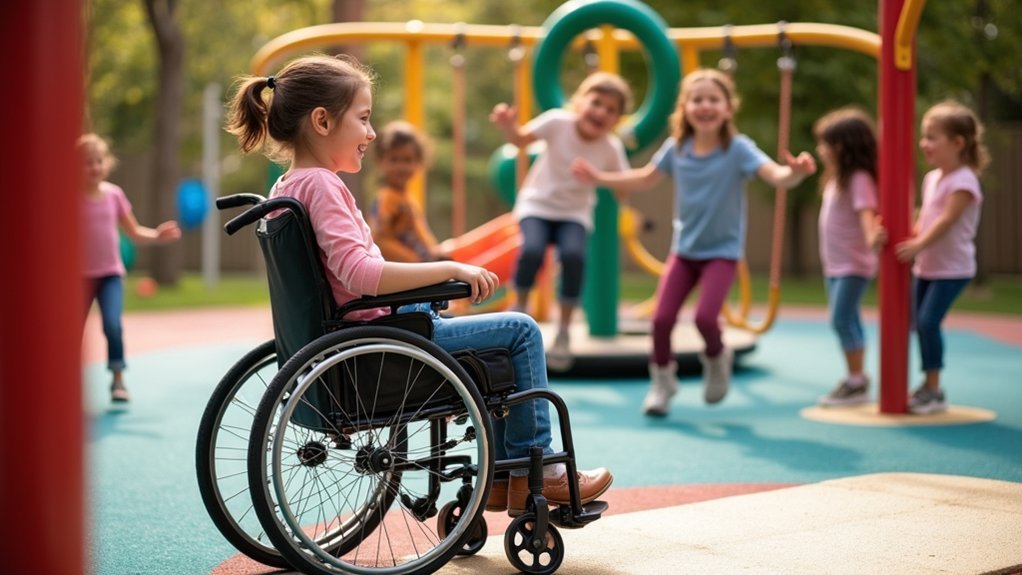
You’ll find wheelchair-friendly merry-go-rounds revolutionizing playground inclusion by accommodating children of all mobility levels in a shared spinning experience.
These innovative rotation platforms feature secure gates, gentle speed controls, and accessible entry points that eliminate barriers to participation.
Beyond traditional carousels, inclusive motion equipment like adaptive swings and gliders lets children build strength and coordination while enjoying the fundamental playground joy of movement together.
Inclusive Rotation Solutions
When children gather at a playground, the spinning equipment often becomes a centerpiece of laughter and excitement.
Modern inclusive rotation solutions allow wheelchair users to join their peers in this joyful experience. Accessible merry-go-rounds can accommodate 10-12 children, including two wheelchair users, creating opportunities for social interaction among children of all abilities.
- Feel the rush of wind as you spin together, creating memories that last a lifetime
- Watch faces light up when everyone, regardless of mobility needs, can play side by side
- Experience the thrill of movement without barriers or separation
- Celebrate the power of inclusive play that strengthens community bonds
- Witness confidence bloom as children discover they can participate fully
These wheelchair-accessible equipment solutions feature safety enhancements like lockable swing gates and speed governors, ensuring everyone spins with confidence.
Beyond Traditional Spinning
Three revolutionary motion designs have transformed playground accessibility beyond traditional spinning equipment.
The Accessible Merry-Go-Round welcomes 10-12 children, including two wheelchair users, creating inclusive playscapes where kids of all abilities enjoy group experiences. With safety features like lockable gates and speed governors, these accessible merry-go-rounds guarantee everyone plays securely.
The innovative We-Go-Swing™ eliminates transfer challenges, allowing children and adults to swing together regardless of mobility limitations. This adaptive motion equipment fosters essential social interaction in the play environment.
Similarly, the Sway Fun® Glider accommodates two wheelchair users alongside peers on benches around a central table, encouraging cooperative play.
Quiet Retreat Spaces With Accessible Seating Options
A well-designed playground recognizes that children need balance between active play and quiet reflection. Incorporating quiet spaces with accessible seating guarantees children with varying mobility needs can find respite when overwhelmed.
These sensory-sensitive environments support emotional regulation while fostering independent play opportunities. You’ll want to include seating that accommodates mobility devices and offers diverse options for children to gather, promoting social interaction in a calmer setting.
These spaces become havens where kids can recharge before returning to more active play areas.
- Cozy Domes provide enclosed retreats for children seeking privacy
- Fox Den Hangouts create imaginative resting spaces accessible to all abilities
- Multi-height seating accommodates different mobility needs
- Sensory-calming elements reduce stimulation for overwhelmed children
- Semi-private areas allow for quiet socialization between friends
Frequently Asked Questions
How Do I Make My Playgrounds More Accessible?
You’ll make your playgrounds more accessible by installing unitary surfacing, adding wheelchair-accessible structures with proper ramps, including ground-level activities, and integrating adaptive equipment that accommodates all children’s mobility needs.
What Are the ADA Guidelines for Playground Accessibility?
ADA guidelines require 60% of playground equipment be accessible, with 36-inch wide routes, stable surfaces, transfer points below 11 inches, and inclusive design elements that accommodate children’s diverse mobility, sensory, and cognitive needs.
How Much Does It Cost to Build an All-Inclusive Playground?
You’ll spend between $300,000 and $1 million to build an all-inclusive playground. Your costs will vary based on size, specialized equipment, accessibility features, and materials you choose for the project.
What Is an All-Abilities Playground?
An all-abilities playground is where you’ll find specially designed equipment and surfaces that let children of all physical and cognitive abilities play together. They’re built with accessibility features that guarantee everyone can participate equally.
In Summary
You’ve seen how inclusive playground design creates spaces where all children can play together regardless of their mobility needs. By incorporating these seven design elements, you’ll create playgrounds that don’t just meet accessibility standards—they exceed them. When you build with unitary surfaces, sensory equipment, and adaptive features, you’re not just building playgrounds. You’re building communities where every child belongs.

Leave a Reply