

These 7 one-arm exercises boost adaptive fitness: Resistance Band Bicep Curls, Adaptive Pull-Up Techniques, Dumbbell Rows, Modified Tricep Extensions with household items, Stability Ball Chest Press, Medicine Ball Core Exercises, and Progressive Shoulder Mobility Training. You’ll develop functional strength while accommodating your unique needs. Start with lighter weights and focus on proper form before increasing intensity. Each exercise can be customized to match your current abilities while challenging you to grow stronger.
Resistance Band One-Arm Bicep Curls
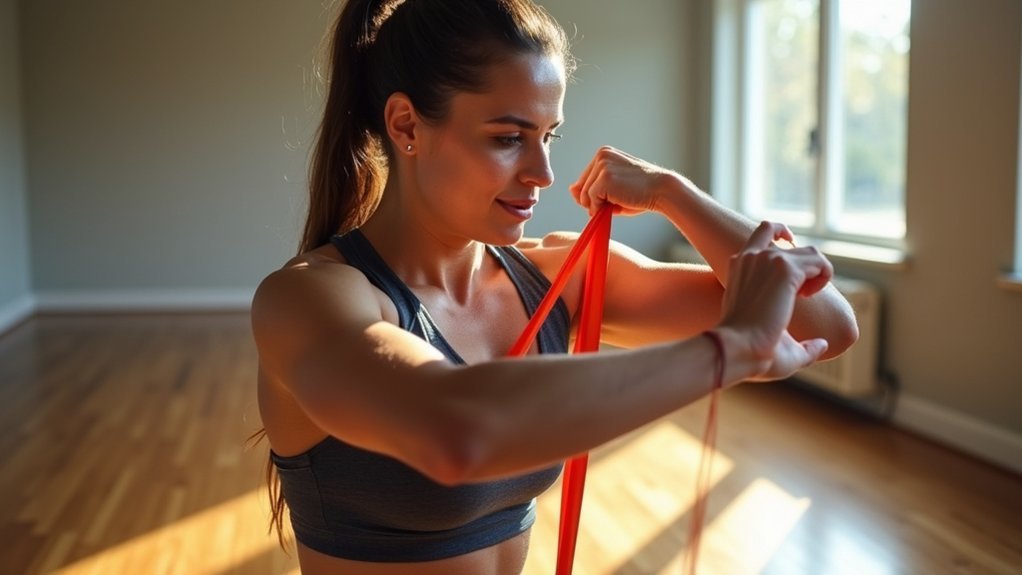
When building strength with limited mobility, resistance band one-arm bicep curls offer an accessible yet effective option for adaptive fitness.
To perform this exercise, anchor the band under your foot, grasp the handle with one hand, and curl toward your shoulder while keeping your elbow close to your body.
If you’re new to adaptive workouts, start with a light resistance band before progressing to medium or heavy options as your strength develops.
Maintain proper form with a straight back and avoid swinging your body during the movement to maximize muscle engagement and prevent injury.
Aim for 10-15 repetitions per set, completing 2-3 sets with adequate rest between them.
This targeted exercise enhances arm strength and control, making it a valuable addition to your adaptive fitness routine.
Adaptive Pull-Up Bar Techniques
Three key adaptations can transform traditional pull-ups into accessible upper body workouts for one-arm training.
Start by using a handle attachment that offers improved grip and support, allowing you to maintain better control throughout the movement. This simple modification can make a significant difference in your exercise quality.
Next, experiment with different arm positions to find your ideal angle. You’ll discover certain positions provide greater comfort and effectiveness, maximizing your strength potential and range of motion.
Finally, don’t hesitate to incorporate resistance bands for assistance. Anchor one end securely and use the band’s upward support as you pull yourself up.
Remember to engage your core throughout the exercise to maintain stability. Explore specialized equipment like modified pull-up bars that accommodate your specific needs while enhancing your workout experience.
One-Arm Dumbbell Rows for Back Strength
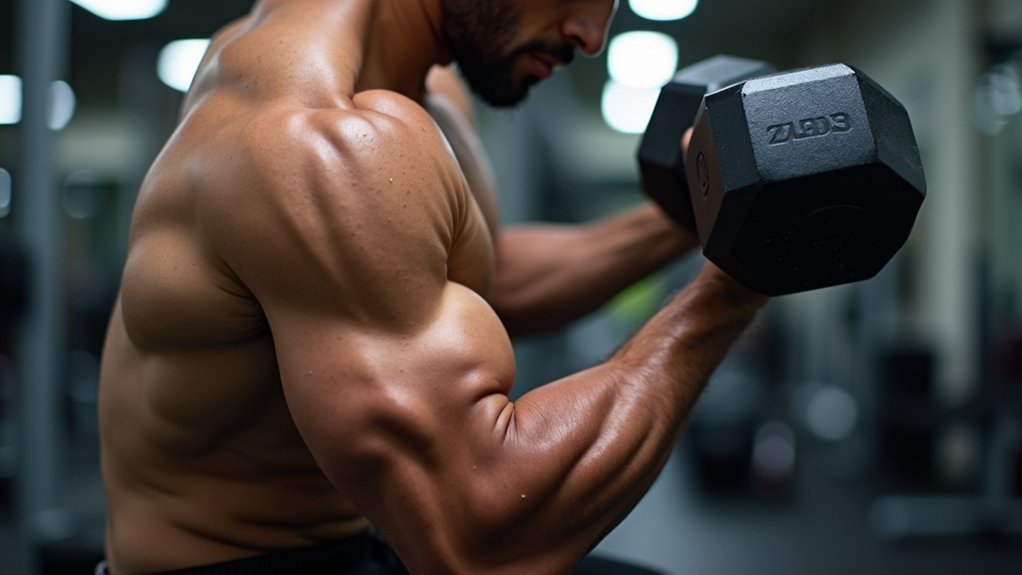
You’ll want to grip the dumbbell firmly with a neutral hand position, keeping your wrist straight and your thumb wrapped around for maximum control during the row.
Start with a weight that allows you to complete 8-12 reps with proper form, then gradually increase the load as your back muscles adapt and strengthen.
This progressive approach guarantees you’re continuously challenging your muscles while minimizing the risk of injury that can occur from jumping to heavier weights too quickly.
Proper Grip Technique
The proper grip forms the foundation of an effective one-arm dumbbell row. When grasping the dumbbell, wrap your fingers firmly around the handle with your thumb positioned on the opposite side for maximum security.
You’ll want to maintain a neutral wrist position—not flexed or extended—to prevent strain on your forearm. As you pull the weight toward your hip, focus on gripping firmly enough to control the dumbbell’s movement without tensing your entire arm. This allows your back muscles to do the primary work.
Many beginners grip too tightly, which can transfer tension to the biceps and shoulders. Remember to adjust your grip strength based on the weight you’re using. Heavier dumbbells require a more secure grip, but never at the expense of proper form and muscle engagement.
Progressive Weight Loading
A strategic approach to progressive weight loading can transform your one-arm dumbbell row from a basic exercise into a powerful tool for back development. By gradually increasing your dumbbell weight as your strength improves, you’ll continually challenge your muscles, promoting balanced strength and preventing plateaus.
| Week | Sets | Reps | Weight | Rest |
|---|---|---|---|---|
| 1-2 | 3 | 12 | Light | 60s |
| 3-4 | 3 | 10 | Medium | 75s |
| 5-6 | 3 | 8 | Heavy | 90s |
| 7-8 | 3 | 10 | Heavier | 75s |
| 9-10 | 3 | 12 | Heaviest | 60s |
Maintain proper form throughout your progression—keep your back flat, core engaged, and movements controlled. This methodical approach not only enhances upper body strength but also improves functional fitness for everyday activities, making daily tasks easier to perform.
Modified Tricep Extensions With Household Items
When creating an effective tricep workout without specialized equipment, household items can serve as excellent resistance tools. Water bottles, cans, or other weighted objects can easily replace dumbbells for one-arm tricep extensions.
To perform this exercise, grasp your improvised weight with one hand and raise it above your head. Slowly lower it behind your head while keeping your upper arm stationary, then extend your arm back to the starting position. Aim for 10-15 repetitions per set.
Hold the weight overhead, bend at the elbow to lower it behind your head, then straighten your arm. Keep upper arm still throughout.
If you’re concerned about balance, use a chair or countertop for support. This modification is particularly helpful for those with limited mobility.
As you build strength, gradually increase the weight of your household items to continue challenging your triceps and improving upper body strength for better functional movement.
Single-Arm Stability Ball Chest Press
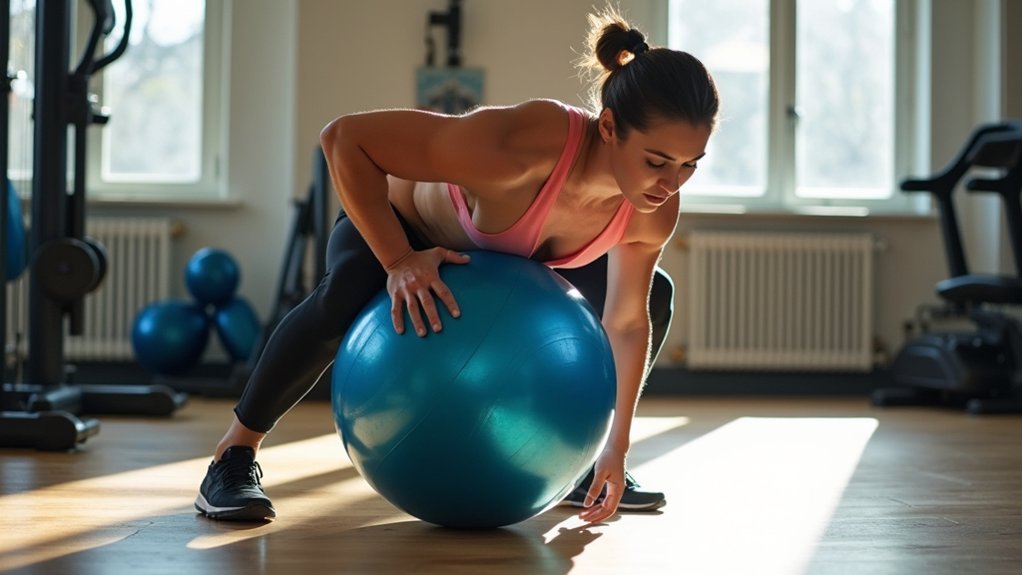
Finding the right ball position is essential for your success with the single-arm stability ball chest press—aim for your upper back to rest securely on the ball with feet firmly planted on the floor.
Your core acts as your foundation during this exercise, so tighten your abdominal muscles throughout the movement to prevent arching your lower back.
You’ll maximize both chest activation and injury prevention by maintaining this strong core engagement, which transforms a simple press into an all-encompassing upper body strengthener.
Ball Positioning Tips
Proper stability ball placement forms the foundation of an effective single-arm chest press. Position the ball securely under your lower back, ensuring your shoulders remain off the ball to maximize range of motion while maintaining stability.
When setting up, your feet should be planted firmly on the floor, hip-width apart, creating a solid base. Your hips should form a straight line with your knees and shoulders to protect your lower back during the exercise.
If you’re using resistance bands instead of dumbbells, anchor them at a point behind you that allows for horizontal resistance. This setup mimics the traditional chest press motion while reducing joint stress.
Remember to adjust the ball size to your height—taller individuals typically need larger balls to maintain proper form throughout the movement.
Core Engagement Importance
Stability serves as the hidden powerhouse behind an effective single-arm chest press. When you perform this exercise on a stability ball, your core muscles automatically activate to prevent rolling and maintain proper alignment, delivering benefits beyond just chest development.
Unlike traditional bench presses, the instability of the ball forces your midsection to work overtime. This engagement corrects muscle imbalances as your body fights to stabilize during each repetition.
Your core fundamentally becomes your anchor, allowing for proper execution while building functional strength.
One-Arm Medicine Ball Exercises for Core Engagement
The medicine ball transforms into a powerful tool for core development when used with just one arm. By challenging your body to stabilize during unilateral movements, you’ll engage your obliques and transverse abdominals far more intensely than with traditional exercises.
The one-arm medicine ball slam and twist particularly enhances rotational strength while improving coordination.
Unleash your rotational power with the one-arm medicine ball slam and twist – a coordination builder that transforms your core stability.
- Creates muscle balance by forcing each side of your body to work independently
- Offers adjustable resistance levels suitable for any fitness stage
- Develops functional strength that transfers to daily activities and athletic performance
You’ll find these exercises particularly valuable for adaptive fitness routines where traditional workouts mightn’t be appropriate.
With consistent practice, you’ll notice improvements in unilateral strength, core stability, and overall movement quality in both exercise and everyday tasks.
Progressive Resistance Training for Shoulder Mobility
Releasing shoulder mobility requires a strategic approach to progressive resistance training—one that gradually challenges your shoulder joint while respecting its complex structure.
By incrementally increasing resistance, you’ll build both strength and flexibility simultaneously, creating more stable and functional shoulders.
Resistance bands are your ideal tools here, offering light, medium, and heavy options to match your current capabilities.
Start with single-arm band pull-aparts to target specific muscle imbalances, then progress to one-arm overhead presses as your stability improves.
These unilateral movements guarantee you’re developing balanced strength across both shoulders.
With consistent practice, you’ll notice improved range of motion and joint stability, making everyday movements feel more natural.
This approach doesn’t just prevent injuries—it transforms your functional capacity in all activities.
Frequently Asked Questions
What Exercises Can I Do With One Arm?
You can do bicep curls, tricep extensions, modified push-ups, single-arm rows, shoulder presses, and kettlebell swings with one arm. Use resistance bands, dumbbells, or your body weight to build strength effectively.
How Do You Work Out One Arm Stronger Than the Other?
To work out one arm stronger than the other, focus on unilateral exercises like single-arm rows or curls. Add extra sets or slightly heavier weights for your weaker arm. Maintain proper form to prevent compensation.
What Is the Number One Arm Exercise?
The one-arm dumbbell row is your best arm exercise. It targets your back, biceps, and shoulders while building strength and stability. You’ll get balanced results if you maintain proper form with your back straight.
What Is the 4 2 1 Workout Split?
The 4-2-1 workout split divides your week into four strength training days, two cardio/active recovery days, and one rest day. You’ll focus on different muscle groups during strength days for balanced fitness development.
In Summary
You’ve got seven versatile exercises that’ll transform your adaptive fitness journey. Whether you’re working with resistance bands, dumbbells, or household items, these one-arm movements build strength, improve mobility, and boost confidence. Start with modifications that match your ability level, then gradually increase intensity as you progress. Remember, consistency is key—even short sessions will yield impressive results when you’re training smart and listening to your body.


Leave a Reply