

The 10 essential strength exercises for stroke recovery include seated marching, knee extensions, chair squats, toe raises, wall sits, shoulder rotations, bicep curls, hand squeezes, finger spreads, and wrist flexion/extension movements. You’ll want to start with 8-10 repetitions, gradually increasing resistance as your strength improves. Perform these exercises 3-5 days weekly in short 10-15 minute sessions for best results. Discover how these targeted movements can transform your recovery journey below.
Understanding Muscle Changes After Stroke
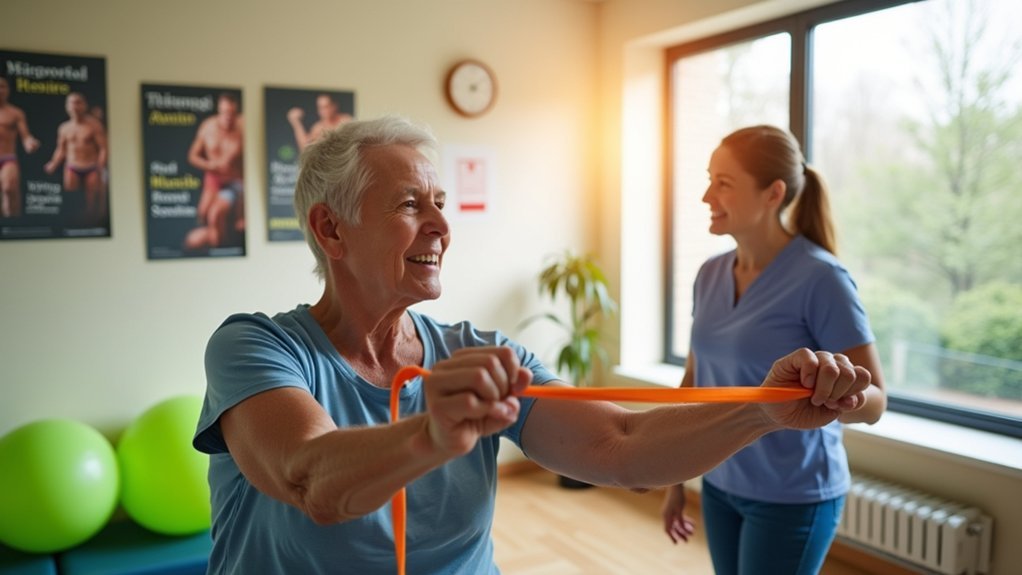
When a stroke occurs, your body undergoes significant muscular transformations that directly impact your recovery journey. Nearly 80% of stroke survivors experience muscle weakness or partial paralysis, limiting your ability to perform daily activities independently.
Stroke fundamentally alters your muscular function, leaving most survivors struggling with daily independence.
Without proper intervention, your affected muscles may become rigid and uncoordinated over time. It’s essential to differentiate between simple weakness and spasticity when designing effective therapeutic interventions.
Targeted stroke recovery exercises can prevent complications like contractures and diminished range of motion. Proper strength training helps restore functionality by addressing these muscular changes directly.
Early rehabilitation exercises are particularly valuable, as they retrain your motor skills and prevent your muscles from shortening permanently. With consistent practice, you’ll gradually rebuild the neural connections needed to regain control of your affected muscles.
Benefits of Strength Training for Stroke Survivors
After experiencing a stroke, your body can greatly benefit from targeted strength training exercises that rebuild weakened muscles.
These rehabilitation exercises considerably improve strength on your affected side, enhancing overall muscle function and mobility.
You’ll notice improved gait patterns with increased step length and better balance, dramatically reducing your fall risk.
Strength training also helps you regain independence in daily activities, directly boosting your quality of life.
Even if you have muscle weakness or spasticity, progressive resistance training allows your body to adapt gradually to increasing exercise intensity.
What’s more, incorporating strength training into your recovery routine positively impacts your mental health and cognitive abilities.
Seated Exercises to Build Lower Body Strength
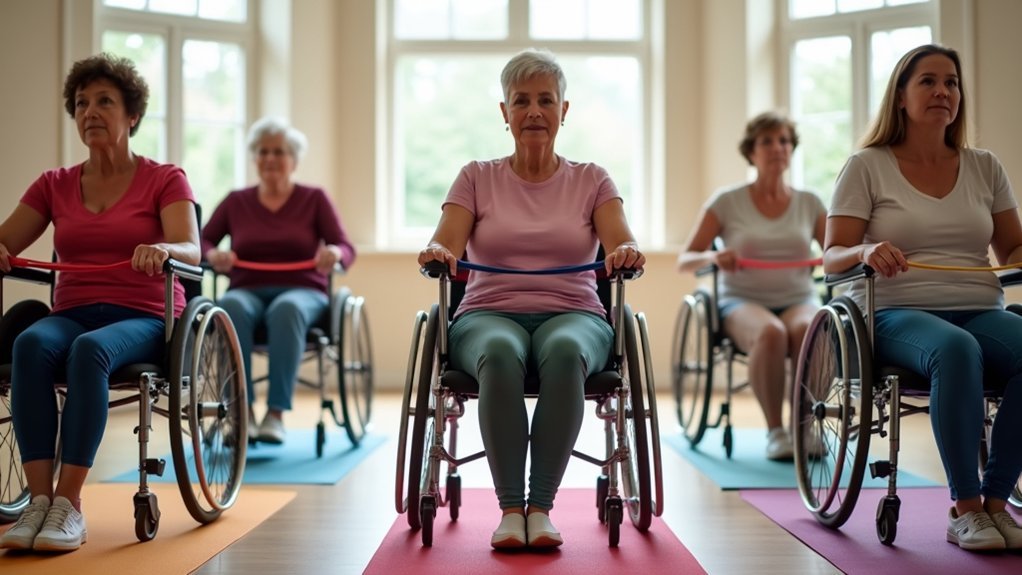
You’ll find seated exercises critical for rebuilding lower body strength during stroke recovery while minimizing fall risks.
Start with chair-based movements like knee extensions, seated marching, and ankle dorsiflexion exercises that can be modified based on your current abilities.
Remember to maintain proper posture throughout these exercises to maximize effectiveness and prevent complications as you work toward improved mobility.
Safe Chair Strength Builders
Five seated exercises can become powerful tools in your stroke recovery journey without requiring you to stand.
These chair-based activities help rebuild lower body strength while promoting mobility and neuroplasticity through consistent practice.
- Ankle pumps – Flex and point your feet regularly to improve circulation and ankle mobility.
- Heel slides – Slide your heel toward and away from the chair to strengthen leg muscles.
- Toe raises – Lift your toes while keeping heels on the floor for 10 repetitions per session.
- Leg lifts – Raise your leg straight out to target hip flexors and quadriceps.
Your rehabilitation routine should emphasize high repetition of these seated exercises.
This approach stimulates neuroplasticity, helping stroke survivors improve leg movement during the critical recovery period.
Modified Seated Leg Workouts
Building on the seated exercises above, modified seated leg workouts offer stroke survivors additional options to strengthen lower extremities without standing.
These exercises effectively target lower body muscles while providing necessary support and stability.
Try seated marching with 20 repetitions to improve hip flexor strength, essential for mobility.
Knee extensions, also performed 20 times, strengthen quadriceps and support standing changes.
Include ankle dorsiflexion 15-20 times to reduce stiffness and improve gait patterns.
These modified exercises considerably reduce fall risk by enhancing balance and leg strength.
Remember to maintain proper posture throughout your workout—sit tall with shoulders back and feet flat on the floor when possible.
This maximizes exercise effectiveness and supports your overall recovery goals.
Standing Exercises to Improve Balance and Stability
After a stroke affects mobility, standing exercises become essential tools for rebuilding balance and stability.
These activities help stroke survivors prevent falls while enhancing their coordination and weight shifting abilities necessary for daily life.
- Toe raises – Stand behind a chair for support and slowly rise onto your toes, holding briefly before lowering.
- Wall sits – Position your back against a wall and partially bend your knees to strengthen leg muscles.
- Chair squats – Practice standing up and sitting down to build functional strength for everyday movements.
- Weight shifts – While standing, gently transfer weight from one leg to another to improve coordination.
For best recovery, perform 10-15 repetitions of each exercise 2-3 times daily, always under guidance from healthcare professionals.
Upper Body Movements for Enhanced Mobility
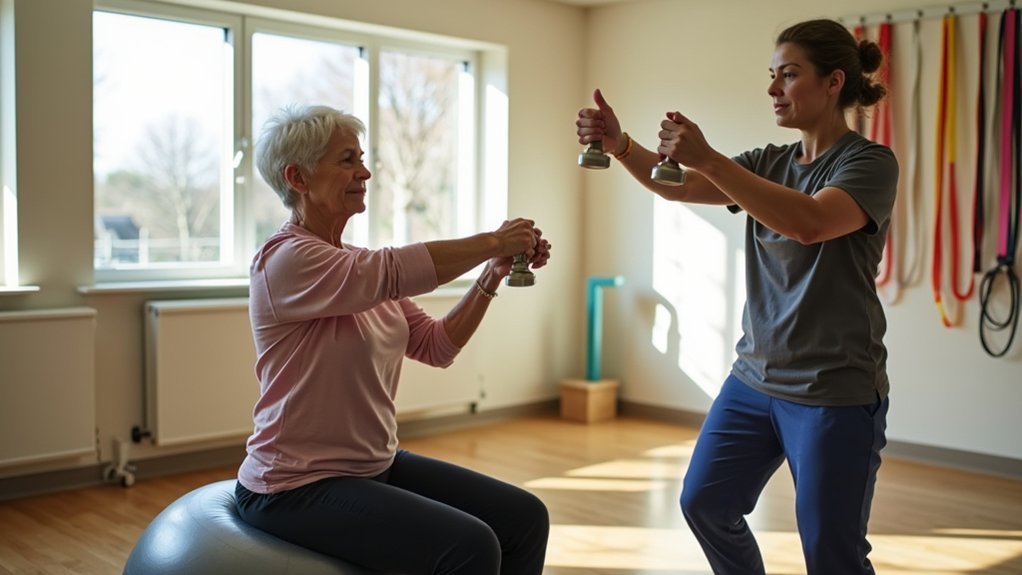
Upper body recovery begins with shoulder rotation techniques that improve external mobility, helping you prevent frozen shoulder while performing open arm exercises 10 times daily.
You’ll strengthen biceps through unweighted curls that progress gradually, enabling essential self-feeding movements and increased independence.
Don’t overlook hand grip exercises, including wrist flexion and surface stretches, which combat contractures and enhance your dexterity for daily activities.
Shoulder Rotation Techniques
When recovering from a stroke, shoulder rotation techniques serve as vital components of upper body rehabilitation. Performing exercises like the Open Arm Exercise can greatly improve your external rotation and mobility, helping prevent common issues such as subluxation and frozen shoulder.
For ideal shoulder rehabilitation:
- Focus on quality – Use controlled movements rather than rushing through repetitions.
- Practice consistently – Aim for 10 repetitions of each exercise to enhance function and range of motion.
- Increase challenge gradually – Incorporate resistance bands or light weights as your strength improves.
- Connect to daily activities – Regular practice contributes to greater independence in tasks like dressing and reaching.
Remember that proper technique is essential to avoid injury while maximizing the effectiveness of your rehab exercises.
Bicep Strengthening Progression
Moving from the foundations of shoulder mobility, bicep strength forms a cornerstone of upper extremity recovery for stroke survivors.
Begin with unweighted bicep curls, performing 10 repetitions per session to rebuild arm bending capacity essential for self-feeding tasks.
Your exercise program should embrace progressive resistance training, gradually increasing intensity as your muscles recover. This methodical approach enhances upper extremity movement while ensuring safety and effectiveness.
Try incorporating visualization techniques while executing each curl to improve movement quality and maintain motivation.
For ideal results, work with healthcare professionals to tailor bicep strengthening exercises to your specific capabilities.
Regular practice not only improves muscle function but also contributes considerably to your overall independence, making daily activities increasingly manageable throughout your recovery journey.
Hand Grip Exercises
Five essential hand grip exercises serve as vital components in stroke recovery, directly targeting fine motor control needed for daily activities.
These techniques help improve grip strength and stimulate neuroplasticity, accelerating your rehabilitation journey.
- Hand squeezes – Compress a soft ball for five seconds, repeating 10 times per hand to improve grip strength and dexterity post-stroke.
- Fist clenches – Make a tight fist, hold for five seconds, then release to enhance hand strength and coordination.
- Finger spreads – Extend and spread your fingers apart for five seconds to increase flexibility and mobility.
- Wrist flexion/extension – Bend your wrist forward and backward 10 times with assistance.
- Surface stretches – Place your hand flat on a table and gently stretch to prevent contractures.
Hand and Wrist Exercises for Fine Motor Skills
After a stroke affects your dexterity, targeted hand and wrist exercises become vital for rebuilding fine motor skills.
Start with hand squeezes using a soft ball—hold for five seconds and repeat 10 times per hand to improve your grip strength and control.
Practice fist clenches by making a tight fist, holding for 5 seconds, then releasing completely. This prevents contractures while enhancing hand function.
For wrist mobility, perform wrist flexion and extension exercises, bending your wrist forward and backward 10 times.
Don’t forget finger spreads—spread your fingers wide, hold for 5 seconds, and repeat 10 times to boost coordination.
Finally, try hand surface stretches across a flat surface to stimulate brain connections essential for dexterity.
Consistent practice of these exercises will progressively restore your ability to perform daily tasks.
Progressive Resistance Techniques for Continuous Improvement
While recovering from a stroke, your muscles need increasingly challenging workloads to continue gaining strength.
Progressive resistance training is ideal for both weak and spastic muscles, helping you regain mobility and independence over time.
For effective muscle recovery during stroke rehabilitation, follow these guidelines:
- Perform 8-10 repetitions per exercise, making certain the last few are challenging enough to promote muscle engagement.
- Gradually increase resistance by modifying body positions, adding weights, or using resistance bands.
- Maintain a consistent schedule of strength training sessions to maximize benefits.
- Practice regularly to allow your muscles to adapt and develop, which supports daily activities.
This structured approach guarantees continuous improvement and helps transform rehabilitation exercises into measurable strength gains.
Visualization Strategies to Enhance Physical Recovery
Visualization techniques offer powerful mental tools that complement physical rehabilitation after a stroke. By mentally rehearsing your rehabilitation exercises, you’re actually strengthening the same neural pathways needed for physical recovery. Your brain often can’t distinguish between imagined and actual movement execution.
When your therapist verbalizes movement sequences, they’re helping you create vivid mental images of exercises before attempting them physically. This practice enhances your performance and can notably improve walking speed and overall mobility.
Make visualization strategies part of your daily routine—you’ll likely experience increased motivation and better focus during therapy sessions.
Adaptive Equipment for Strength Training
Selecting the right adaptive equipment can dramatically transform your strength training routine after a stroke.
These tools offer customized support while building your strength and confidence during recovery.
- Resistance bands and weighted wristbands – Provide adjustable resistance that grows with your abilities, making strength training accessible at any recovery stage.
- Hand exercisers and grip aids – Help you regain dexterity and hand strength even with limited mobility.
- Balance boards and stability balls – Enhance core strength while safely challenging your balance.
- Chair lifts and standing frames – Support functional strength training exercises like sit-to-stand movements.
Creating a Sustainable Home Exercise Routine
Because recovery continues long after formal rehabilitation ends, establishing a consistent home exercise routine becomes crucial for ongoing stroke recovery progress. Start with short 10-15 minute sessions 3-5 days weekly, gradually building as your strength improves. Your physical therapist can provide exercise recommendations tailored to your specific needs.
Combine upper and lower body stroke rehabilitation exercises to improve core strength and coordination. Begin with simpler movements like seated marches or bicep curls, then progressively increase difficulty as patients recover function.
Using rehabilitation technology can dramatically boost your repetition count—potentially achieving 400 repetitions in 30 minutes versus just 32 in traditional therapy.
Maintain regular consultations with your healthcare team to guarantee your home exercise routine remains safe and effective as you advance through recovery.
Frequently Asked Questions
What Is the Best Exercise to Recover From a Stroke?
You’ll benefit most from a mix of progressive resistance training, functional exercises like squats, and aerobic conditioning. Consult a physical therapist for personalized exercises that match your specific recovery needs.
How to Regain Muscle Strength After a Stroke?
You’ll regain muscle strength after a stroke through progressive resistance training 3-5 days weekly. Focus on 8-10 repetitions of exercises like sit-to-stands and bicep curls that challenge you and mimic daily activities.
What Is the 4-Hour Rule for Stroke?
The 4-hour rule means you should seek emergency medical care within four hours of stroke symptoms. You’ll have better recovery chances if treatment begins quickly, as every minute counts in preventing brain damage.
What Heals the Brain After a Stroke?
Your brain heals after a stroke through neuroplasticity—forming new neural connections. You’ll boost recovery with physical exercise that increases BDNF, mental training techniques, and consistent high-repetition exercises that strengthen neural pathways.
In Summary
You’ve now got the tools to rebuild your strength after stroke. Remember, it’s not just about regaining muscle—you’re reclaiming independence with each movement. Start slowly, celebrate small victories, and don’t hesitate to modify exercises as needed. With consistent practice and patience, you’ll continue making progress. Your recovery journey is uniquely yours, and these strength exercises are powerful steps forward on that path.

Leave a Reply