

Protective riding helmets save lives by absorbing and distributing impact energy during accidents. The hard outer shell and EPS foam liner work together to reduce force on your skull by up to 60%, turning potentially fatal injuries into survivable ones. Properly fitted, certified helmets greatly lower your risk of traumatic brain injuries and serious head trauma. Regular inspection and replacement after impacts guarantee continued protection. Discover how proper sizing and maintenance can make the critical difference in your safety.
The Science Behind Head Protection Technology

While riding offers a sense of freedom, your helmet serves as the most critical piece of safety equipment you’ll wear. Modern motorcycle helmets feature a hard outer shell and soft inner foam liner that work together to absorb and distribute impact energy during crashes.
When you’re wearing a helmet that meets DOT standards, you’re reducing your risk of serious head injuries by up to 60% and traumatic brain injuries by 53%. This impressive protection comes from materials like expanded polystyrene (EPS) that dissipate forces that would otherwise concentrate on your skull.
Though no protective gear can completely prevent concussions, your helmet is engineered to minimize brain injury severity by cushioning your head and limiting its movement during impact—turning potentially fatal accidents into survivable ones.
Impact Distribution and Energy Absorption Features
Modern riding helmets protect your head through two critical mechanisms: crumple zones that absorb crash energy much like those in automobiles.
Your helmet’s hard outer shell distributes impact forces across a wider area, preventing concentrated trauma to any single point on your skull. This force-dispersing design works in conjunction with the compressible foam lining to reduce the acceleration forces your brain experiences during a collision.
Crumple Zones Work
Just as cars protect passengers through strategic collapse during collisions, protective riding helmets employ sophisticated crumple zone technology to safeguard your brain.
When you crash, your helmet’s rigid outer shell immediately deflects the initial impact forces, but it’s the inner foam layer that truly saves you.
These crumple zones compress upon impact, absorbing dangerous energy that would otherwise transfer to your skull. This energy-absorbing design spreads the force across a larger area, preventing concentrated damage to vulnerable spots.
It’s remarkably effective—helmets reduce your risk of head injuries by up to 48% and serious head trauma by 60%.
You’ll notice the difference between a damaged helmet and an undamaged skull. The helmet sacrifices itself through controlled deformation, so you don’t have to.
Force-Dispersing Shell Design
The force-dispersing shell design works in tandem with those crumple zones to create a thorough protection system. When you’re involved in a collision, your helmet’s hard outer shell (typically made of polycarbonate or fiberglass) immediately goes to work spreading impact forces across a larger area of your head rather than concentrating them in one spot.
Beneath this shell, the impact-absorbing liner—usually constructed from expanded polystyrene (EPS)—compresses during impact, absorbing vital energy that would otherwise transfer to your skull.
This engineering marvel can reduce the risk of severe head injuries by up to 60% and traumatic brain injuries by 53%.
Modern motorcycle helmets meeting rigorous safety standards employ this dual-protection approach precisely because it’s proven to prevent serious injury when you need protection most.
Critical Safety Certifications and Testing Standards
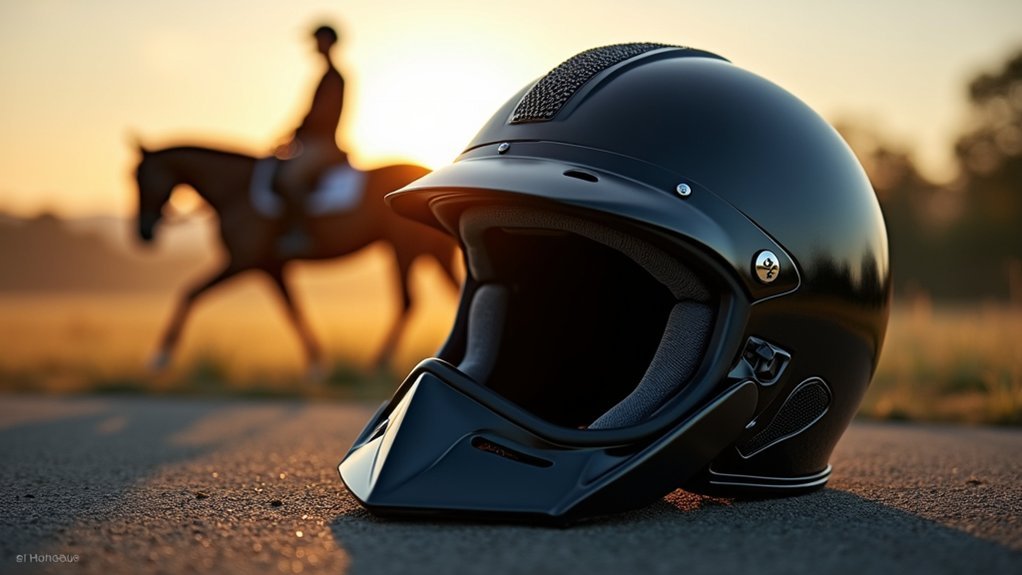
When selecting a protective riding helmet, you’ll need to verify it meets DOT safety standards through the sticker on the back, confirming it has passed rigorous impact resistance and strap strength testing.
Additional certifications from Snell Memorial Foundation or ECE indicate your helmet has undergone even more stringent impact absorption tests beyond minimum requirements.
You should always purchase from reputable dealers to avoid counterfeit helmets with fake certification stickers that won’t provide adequate protection during accidents.
Certification Impact Assessment
Recognizing the difference between properly certified and non-certified helmets can literally save your life during a motorcycle accident. Helmets must meet Department of Transportation (DOT) standards to legally provide the protection you need on the road.
When you choose a properly certified helmet, you’re greatly reducing your risk of head injury.
Consider these critical certification impacts:
- DOT-certified helmets absorb considerably more impact energy than non-certified alternatives.
- Helmets that meet additional Snell or ECE certification standards provide enhanced protection beyond minimum requirements.
- Counterfeit helmets with fake DOT stickers offer virtually no protection in serious crashes.
- The standards set by certification organizations guarantee your helmet has undergone rigorous testing for real-world accidents.
Impact Testing Procedures
Before a helmet reaches store shelves, it undergoes a series of rigorous impact tests designed to simulate real-world crash scenarios. These procedures evaluate how effectively helmets are an essential barrier between your skull and potentially fatal impacts.
The Federal Motor Vehicle Safety Standard requires multiple impact tests at varying speeds, measuring the helmet’s ability to absorb and distribute crash forces.
Penetration testing guarantees sharp objects can’t breach the outer shell, while strap strength assessments confirm the helmet stays in place during accidents.
Look for the DOT sticker on the back—this indicates compliance with federal safety standards. For motorcycle riders seeking maximum protection, consider helmets with additional Snell certification, which subjects helmets to even more demanding tests.
These certifications considerably reduce your risk of death during collisions.
Proper Helmet Fit: The Key to Maximum Protection
Three critical elements determine whether your riding helmet will protect you effectively during an accident: proper sizing, secure positioning, and correct fastening.
To achieve the best helmet fit and reduce your risk of head injuries:
- Measure your head circumference just above your eyebrows and match this to the manufacturer’s sizing chart.
- Verify your helmet sits snugly without shifting when you shake your head.
- Fasten the chin strap tightly enough that only one finger fits between the strap and your chin.
- Check your helmet’s fit regularly as weight changes or haircuts can affect its security.
Real-World Success Stories: When Helmets Made the Difference

While statistics provide compelling evidence for helmet use, the real power of protective headgear becomes most apparent through individual survival stories.
Consider the rider who walked away with minor injuries after a motorcycle accident while wearing a helmet, compared to an unhelmeted rider who suffered traumatic brain damage in a similar crash—a stark life and death contrast.
The numbers back these stories: helmets reduce the risk of head injury by 48%, and serious head injuries decrease by 60% when helmets are worn.
Between 2002 and 2017, over 25,000 lives were saved by these protective devices.
One survivor credits their helmet’s design for absorbing a high-speed impact that could have been fatal.
These real-world examples demonstrate why wearing a helmet isn’t just a safety precaution—it’s a life-preserving decision.
Helmet Maintenance and Replacement Guidelines
Even the most advanced helmet can fail if improperly maintained. Your helmet’s protective integrity depends on proper care and timely replacement.
Proper maintenance isn’t optional – it’s the difference between a helmet that saves your life and one that fails when needed most.
Don’t compromise your safety by neglecting these essential maintenance practices.
For ideal motorcycle helmet safety performance:
- Inspect regularly – Check for signs of damage including cracks, dents, or compromised shell integrity before each ride.
- Replace after impacts – After any crash, replace your helmet immediately even if it appears undamaged.
- Follow the five-year rule – Replace helmets every five years regardless of visual condition as materials degrade over time.
- Store properly – Keep your helmet in a cool, dry place away from direct sunlight and extreme temperatures.
Never purchase used helmets since you can’t verify their impact history or structural integrity.
Frequently Asked Questions
Why Do Helmets Save Lives?
Helmets save lives because they’ll protect your head by absorbing impact energy during accidents. You’re 69% less likely to suffer head injuries and 42% less likely to die when you wear one.
Do Helmets Really Protect Against a Crash?
Yes, helmets really do protect you during crashes. They considerably reduce your risk of head injuries by 48% and serious brain trauma by 60%. You’re 42% less likely to die when you’re wearing one.
How Many Lives Are Saved by Helmets?
Helmets have saved over 25,000 lives in the US from 2002-2017. You’re 37% less likely to die in a motorcycle accident when you’re wearing one. They’re incredibly effective at preventing fatal head injuries.
How Effective Are Helmets in Preventing Fatal Injuries?
Helmets are highly effective in protecting you. They reduce your risk of fatal injuries by up to 37% and can decrease serious head injuries by 60%. You’re considerably safer when you’re wearing one while riding.
In Summary
You’ve now seen how helmets protect your brain through advanced impact technology, rigorous testing, and proper fit. Don’t gamble with your life—a certified, well-maintained helmet isn’t optional equipment. Remember to replace your helmet after impacts or every 3-5 years. The statistics and survival stories speak for themselves: when you’re facing a fall, your helmet is often the difference between walking away or not.




Leave a Reply